If you’ve been raped or sexually assaulted, it’s never your fault. Myths about clothing, drinking, or reactions during an attack do not excuse the perpetrator’s actions. If you didn’t consent, it’s sexual assault. Survivors may be manipulated by those in power or feel guilt for not fighting back, but freezing is a normal response. Coercion, threats, or manipulation do not shift the blame. Responsibility always lies with the perpetrator, not you.
Survivors of sexual assault may be facing a double injustice. The physical and psychological wounds you have suffered from the attack may never fully heal. While your attacker may have to answer to criminal charges, this will not compensate you for the medical treatment, counseling, and emotional scars you may bear for years to come.
Our firm is ready to stand by your side throughout every step of the process, helping you fight for the fair and adequate compensation you so rightfully deserve. Please do not hesitate to call us for a free consultation about how we can help. Hablamos español.
If you’ve been raped or sexually assaulted, it’s never your fault. Myths about clothing, drinking, or reactions during an attack do not excuse the perpetrator’s actions. If you didn’t consent, it’s sexual assault. Survivors may be manipulated by those in power or feel guilt for not fighting back, but freezing is a normal response. Coercion, threats, or manipulation do not shift the blame. Responsibility always lies with the perpetrator, not you.
Survivors of sexual assault may be facing a double injustice. The physical and psychological wounds you have suffered from the attack may never fully heal. While your attacker may have to answer to criminal charges, this will not compensate you for the medical treatment, counseling, and emotional scars you may bear for years to come.
Our firm is ready to stand by your side throughout every step of the process, helping you fight for the fair and adequate compensation you so rightfully deserve. Please do not hesitate to call us for a free consultation about how we can help. Hablamos español.
If you’ve experienced sexual assault or abuse, we want you to know that the responsibility for what happened lies entirely with the perpetrator. Misconceptions about how someone should respond, what they were wearing, or whether they fought back do not change that fact. Feeling guilt or shame after an assault is common, and freezing or feeling unsure is a natural reaction—not a sign of weakness. For additional support and guidance, our sexual abuse resources page offers more information for survivors.
Sexual assault can leave lasting physical and emotional effects. Even if the perpetrator is charged for their crimes, criminal proceedings can’t address the full scope of the harm you’ve suffered. Medical bills and emotional trauma can follow you long after the attack, and you have the right to seek compensation for your losses.
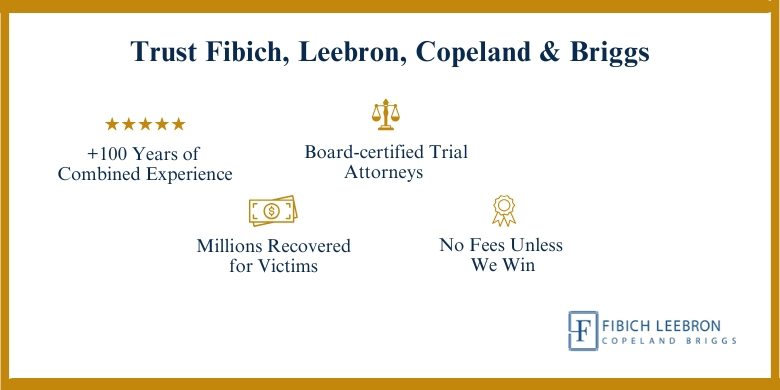
Fibich, Leebron, Copeland & Briggs has represented clients in Houston and across Texas for decades. We pride ourselves on handling complex civil and personal injury cases with skill and compassion—including sexual assault claims. Our board-certified attorneys provide experienced guidance to help survivors pursue compensation after a sexual assault.
We’re committed to standing by your side throughout each step of your case. Contact us for a free consultation and learn more about your options. Hablamos español.
To consult with an experienced sexual assault lawyer serving in Houston, call 713-751-0025 today.
How Our Attorneys Approach Sexual Assault Cases
Litigating a sexual assault case requires experience and attention to detail—and above all, understanding the emotional impact on survivors. Fibich, Leebron, Copeland & Briggs brings decades of experience in complex civil litigation. When you work with us, you can be confident that your case is in capable hands:
We start by thoroughly investigating every aspect of the assault. This includes gathering evidence and consulting expert witnesses when necessary.
We determine the strongest legal approach for your unique situation.
We build your case with a focus on pursuing compensation for everything from medical bills and lost income to emotional suffering and therapy bills.
You’ll work directly with an attorney who knows how to hold the responsible party accountable in a sexual assault civil lawsuit. Every sexual assault case is different, so we adapt our strategies to fit your needs. Our lawyers understand how sensitive these situations are. We make sure your voice is heard and your rights are protected throughout the case.
Attorney Erin K. Copeland is a partner with Fibich, Leebron, Copeland & Briggs. Throughout her career, she has advocated for those who have experienced sexual trauma and sexual violence. She proudly serves on the American Association for Justice Board of Governors, and she has recovered hundreds of millions on behalf of injured victims.
What Is a Civil Sexual Assault Lawsuit?
There is a distinct difference between criminal cases and civil cases. The state determines whether to file and pursue criminal charges against an individual for sexual assault, not the victim. Criminal cases determine guilt or innocence and establish a penalty for those convicted of a criminal offense, such as fines and prison time.
Civil lawsuits are different. Victims of intentional sexual assault can file a civil lawsuit. In their suit, they can prove that it is more likely than not that the perpetrator committed the violent act and, therefore, owes the victim financial compensation for their medical expenses and other losses related to the sexual assault or battery.
Civil and criminal cases are separate legal proceedings meant to accomplish different things. Criminal cases punish wrongdoing, and civil cases aim to gain compensation for the victim’s losses.
Sexual abuse of someone who cannot give consent due to disability or mental capacity
Forcible and violent intercourse, penetration or sexual contact, even with consent
Texas law defines sexual abuse as occurring in the context of an individual receiving certain services, such as a state employee who is providing services to a citizen. In that context, sexual abuse can take the form of:
A service provider kissing, hugging, stroking, or fondling an individual with sexual intent
A service provider any activity defined as obscene in the Texas Penal Code
A service provider requesting, soliciting, or compelling another person to engage in obscene activity
Committing sexual exploitation, sexual assault, or aggravated sexual assault
Photographing or videotaping activities that could be considered pornographic
An experienced sexual assault attorney can explain more about the differences between sexual assault and sexual abuse if you are curious about your rights under Texas law as a survivor.
Types of Sexual Abuse & Sexual Assault
Sexual assault includes any unwanted sexual contact without consent. This includes everything from unwanted groping to rape and sexual coercion. Common types of sexual abuse and assault include:
Rape – Non-consensual sexual intercourse.
Sexual assault – This broad category includes unwanted touching, fondling, or penetration.
Sexual harassment – Unwelcome sexual advances or conduct in professional or educational settings.
Exploitation – Using someone in a sexual act or video without their consent.
Coercion and manipulation – Forcing or pressuring someone to participate in sexual activity against their will.
The type of sexual assault involved in your case helps us evaluate the potential damages and legal remedies. Our Houston sexual assault attorneys can explain your options and what you can expect from your claim.
Where the abuse took place can help our attorneys collect evidence for a civil claim. We work with law enforcement and other entities to strengthen your sexual assault lawsuit.
What Is the Process for Filing a Lawsuit?
First, discuss your situation with a Houston lawyer who has experience representing survivors of sexual assault. A sexual assault attorney can outline your legal options and walk you through the process of filing a sexual assault civil lawsuit. Filing suit involves:
An attorney can file the paperwork against the alleged perpetrator and help determine whether other entities may be liable for compensating you for your injuries.
Sexual Abuse on College Campuses
The number of sexual assaults that occur on college campuses and universities is staggering. Despite numerous studies about the widespread problem and complete failure to protect students and staff, the unsettling trend continues. Men and women at Texas institutions and schools throughout the country continue to be the victims of horrific sexual trauma. Statistics of sexual assault at colleges and universities:
Of the female undergraduate students surveyed at the University of Texas at Austin, fifteen percent reported that they had been raped. (The Dallas Morning News)
Thirteen percent of undergraduate and graduate student rapes and sexual assaults are done through the use of “physical force, violence, or incapacitation.” (RAINN)
Instances of sexual assaults on college campuses are not only under-reported by victims but may also be under-reported by the institution, including 30 instances of rape that went unreported by Texas State University in 2016 and 2017. (The Texas Tribune)
Holding Liable Parties Responsible for Sexual Abuse
In sexual assault cases, there may be multiple parties that should be held liable. Not only can a civil lawsuit be brought against an individual perpetrator but also against a third-party whose negligence or wrongdoing may have allowed the abuse to occur.
Sadly, sexual assault can happen almost anywhere, and particularly in the case of children is often committed by someone the victim trusts or is in a position of authority.
Sexual assault and abuse can occur anywhere by anyone. Too often, people in trusted positions of power abuse their authority and commit unthinkable acts against those they should protect. When predators carry out these offenses, they and any other negligent parties must be held accountable. Sexual assault can be committed by anyone, but people in positions of power often prey on unsuspecting individuals. Examples of authority figures that may perpetrate these acts include:
Property Owners Have a Responsibility to Protect You
Sexual assault injury cases are often premises liability cases. Property owners have a responsibility to ensure that parking lots, ramps, stairwells, and other out-of-the-way places on their property are adequately lit and secured to prevent violent attacks. If you were injured under these circumstances, it is your right to pursue a personal injury claim. When a property owner fails to provide reasonably safe premises resulting in harm to you or a loved one, they may be responsible for damages related to your injuries. It is imperative to discuss your case with an experienced lawyer as soon as possible to determine your legal options and your ability to recover against a negligent property owner.
The Prevalence of Child Abuse
One of the most egregious forms of sexual assault is when it is perpetrated against a child. In all sexual assault cases, there may be criminal and civil liability. Depending on the situation, the person or persons who committed the act, as well as any negligent third parties, may be held liable for damages. Unfortunately, many victims of sexual assault and assault never come forward. According to the Children’s Assessment Center, The Advocacy Center for Houston and Harris County (CAC Houston), the true scope of the problem remains unknown as professionals fear that many victims of childhood sexual assault “do not disclose or report their abuse.” Researchers believe that the prevalence of child sexual abuse could be as high as 35 percent. As many as 1 in 4 women and 1 in 6 men report experiencing sexual assault before adulthood.
Your Legal Options as a Sexual Assault Survivor
Sexual assault victims in Texas often have legal options beyond criminal prosecution. Criminal cases involving sexual assault charges require the prosecution to prove its case beyond a reasonable doubt. Civil claims, on the other hand, have a lower standard of proof and can provide financial compensation for your losses. Your legal options may include:
Filing a civil lawsuit against the perpetrator – This allows you to seek monetary damages directly from the responsible party.
Filing a claim against a third party – Sometimes assaults happen due to negligence, such as a rideshare company failing to screen drivers or a workplace failing to protect employees. When that happens, you may pursue a claim against that entity.
Negotiating settlements – Many sexual assault cases resolve through settlements, which can provide compensation without the emotional strain of a trial. However, if we can’t negotiate a fair settlement, we are prepared to take your case to trial.
The Devastating Impact of Sexual Abuse
Many survivors of sexual abuse or assault never completely heal from the trauma. It can take years of counseling to even begin to feel comfortable in your skin. Therapy can be expensive but may be essential to helping you cope with what has happened. Bringing a lawsuit may help you recover some of the costs associated with the assault. Damages resulting from sexual assault can include but are not limited to:
Medical expenses
Costs related to therapy and counseling
Lost wages
Loss of future earning capacity
Pain and suffering
According to RAINN, 94 percent of women rape survivors suffer from post-traumatic stress disorder (PTSD), and thirteen percent of women who are raped attempt suicide. If you have lost a loved one who was the victim of sexual trauma, you might be entitled to bring a wrongful death claim with the help of a lawyer.
Recoverable Damages in Sexual Abuse Claims
Victims can recover a wide range of damages in sexual assault claims. These include:
Medical expenses
Lost wages and income
Pain and suffering
Mental health counseling
In rare cases, courts may award damages to punish the perpetrator or negligent party. These are called punitive damages. Our attorneys evaluate every potential avenue for compensation so that your potential financial recovery reflects the harm you suffered.
“Thanks to the hard work and dedication from Kelly and Diana at Fibich, Leebron, Copeland, Briggs, I achieved a favorable outcome that exceeded my expectations. I am immensely grateful for their support and would highly recommend them to anyone in need of legal assistance. Not only did they exceed my expectations in terms of legal representation, but they also showed a genuine concern for my well-being. If you’re looking for a law firm that truly cares about its clients and delivers exceptional results, look no further than Fibich, Leebron, Copeland, Briggs.” – by Hannah via Google
“I have been working with them for a while, they have always been on top of everything! They show that they care about your case and you! I highly recommend them to anyone looking for an amazing law firm!” – by Steffani on Google
Why Choose Our Sexual Assault Attorneys?
Fibich, Leebron, Copeland & Briggs has represented clients in Houston and across Texas for decades. We combine hands-on experience with board-certified qualifications to handle complex and sensitive cases. Our attorneys have successfully pursued multimillion-dollar verdicts and participated in multidistrict litigation, including Fen-Phen, Vioxx, and Topamax cases.
We understand the emotional strain of sexual assault and focus on thorough preparation, aggressive representation, and clear communication. You can expect:
Board-certified trial attorneys handling your case
Personal attention from a legal team experienced in civil litigation and personal injury
Strategic guidance to pursue the maximum recovery available under Texas law
Representation for all types of sexual assault, including cases in workplaces, schools, and transportation settings
Get in Touch with an Experienced Houston Sexual Assault Lawyer
If you are a sexual assault survivor in Houston, you deserve legal representation that fights for your rights and compensation. Contact Fibich, Leebron, Copeland & Briggs for a free consultation. Our team will listen to your story and help you determine the best path forward.
Sexual Assault Frequently Asked Questions
Coming forward is one of the hardest decisions anyone can make as a sexual assault survivor. If you’re trying to figure out your options, know that you’re not alone, and you don’t have to have everything figured out before you seek help. The following are some straightforward answers to questions you might have before you take your next steps.
Should I Report My Sexual Assault to the Police? What Are the Pros and Cons?
The decision to report sexual assault to the police is a deeply personal one. If you choose to file a report, it can create an official record, help you connect with victim services, and prevent the perpetrator from harming others. At the same time, the process of reporting sexual assault can feel daunting, and some survivors worry about others not believing them or scrutinizing their personal lives.
It’s worth noting that anonymous sexual assault reporting options exist in Texas (such as through sexual assault nurse examiner (SANE) programs) that allow you to preserve evidence without immediately filing a police report. The benefits and risks of reporting sexual assault depend on your specific situation, and an attorney can help you understand your options when you are conflicted over the question “Should I report my sexual assault?”
Can I Sue Those Responsible?
Yes. A civil lawsuit is separate from any criminal case, and you can pursue one regardless of whether the perpetrator is ever charged or convicted. In Texas, adult survivors of sexual assault generally have five years to file a civil claim, while survivors of child sexual assault have 30 years. A successful civil case can provide financial compensation for your medical costs, mental anguish, and other losses you’ve suffered.
What Evidence Is Most Important in a Sexual Assault Case?
Key evidence often includes medical records, communications between you and the perpetrator, witness accounts, and any documentation of the assault itself. Delayed reporting is common and widely accepted by courts across the country, so don’t assume that you’re out of options just because time has passed.
Will My Sexual History or Past Behavior Be Brought Up in Court?
Texas’s rape shield law limits the use of a survivor’s sexual history in court proceedings. While defense attorneys may attempt to introduce such information, the law protects you in these circumstances, and your legal team can work to keep irrelevant personal details out of the courtroom.
How Long Does a Sexual Assault Case Usually Take?
Civil sexual assault cases vary widely in duration. Simpler cases may resolve in one to two years, while more complex litigation can take longer. Your attorney can give you a clearer timeline once they’ve reviewed the specifics of your situation.
What Confidentiality Protections Are Available If I Come Forward?
Texas law provides several confidentiality protections for survivors, including restrictions on public disclosure of identifying information. Your lawyer can explain which protections apply to your case.
How Can a Sexual Assault Lawyer Help Me Beyond Just Going to Court?
A sexual assault attorney can help you document your experience, connect you with medical and mental health resources, communicate with insurance companies and opposing counsel on your behalf, and guide you through every stage of the legal process. You won’t have to face any of this alone.
Office Hours
Monday
Open 24 hours
Tuesday
Open 24 hours
Wednesday
Open 24 hours
Thursday
Open 24 hours
Friday
Open 24 hours
Saturday
Open 24 hours
Sunday
Open 24 hours
Sticky note tool
You're about to use our sticky note tool to submit website requests to our team. Click the "Accept"
button to download a cookie that will authorize you to see and use the tool on this device.
To leave a Sticky note, click the comment button and then click anywhere on the page.
0
Comment
We couldn't activate the sticky note tool. Please reload the page and try
again — if it keeps happening, let your site contact know.