
The Hidden Paper Trail Behind Every Houston 18-Wheeler Crash
Key Takeaways: A driver qualification file (DQF) is the federally required safety file that 49 C.F.R. § 391.51 obligates motor carriers to maintain on each commercial driver. It must contain the employment application, state licensing inquiries, motor vehicle records, annual reviews, road test certification, and medical qualification documents. In a Houston 18-wheeler crash, gaps in that file can transform a case from a driver’s mistake into a claim of negligent hiring and retention against the carrier. Texas law, under Tex. Civ. Prac. & Rem. Code § 72.054(c), permits evidence about licensing, disqualification, road testing, and medical certification. Because retention rules allow lawful destruction of certain records after three years, and Texas generally allows two years to file suit under § 16.003, prompt preservation demands are critical.
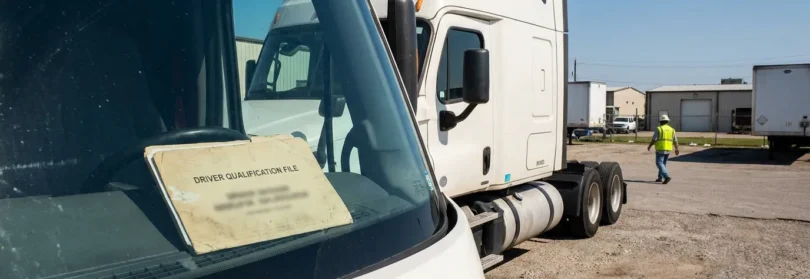
A driver qualification file is the federally mandated personnel and safety file that a trucking company must keep on every driver under 49 C.F.R. § 391.51(a). In a catastrophic Houston 18-wheeler crash, that file reveals whether the company hired a driver it should not have, verified medical fitness, and checked driving history before sending an 80,000-pound vehicle onto I-45, the 610 Loop, or the Sam Houston Tollway.
If you or a family member suffered life-altering injuries or wrongful death in a collision with a commercial truck, the trial team at Fibich, Leebron, Copeland & Briggs is prepared to pursue the carrier’s records and seek corporate accountability. Call 713-751-0025 or contact us now to discuss your case.

What a Driver Qualification File Must Contain Under 49 CFR 391
Federal regulation specifies the contents of a commercial driver file. Under 49 C.F.R. § 391.51(b)(1)-(5), the DQF must include the driver’s employment application, state licensing authority responses, road test certificate, annual MVR inquiry response, and written documentation of annual driving record review. Safety performance history investigation records are maintained separately under § 391.53.
Medical fitness documentation forms a critical second layer. Under 49 C.F.R. § 391.51(b)(6)(i)-(iii), the file must contain the medical examiner’s certificate, the CDLIS motor vehicle record showing medical certification status for CDL holders, and any FMCSA medical variance documentation. When carriers cannot produce these, counsel may argue the company failed to confirm the driver was physically qualified.
Retention rules matter as much as content rules. Under 49 C.F.R. § 391.51(c) and (d)(1)-(3), the driver qualification file is kept for the employment period plus three years afterward, although certain records may be removed three years after execution. These staggered timelines mean driver qualification file retention rules can allow lawful destruction of key pages unless a preservation obligation has attached.
Why the File Is Powerful Evidence of Corporate Negligence
A DQF can turn an individual driver’s mistake into institutional failure. If the file shows the carrier never ran required background inquiries, never obtained a medical certificate, or renewed a driver with repeated violations, the case may extend beyond vicarious liability into direct negligent hiring and retention theories against the company, subject to Texas rules that can limit direct claims when the employer stipulates to course-and-scope.
How Texas Law Makes the Driver Qualification File Truck Accident Evidence
Texas statutory law expressly opens the door to this evidence. Under Tex. Civ. Prac. & Rem. Code § 72.054(c), parties may introduce evidence of whether the driver was licensed, disqualified under 49 C.F.R. §§ 383.51, 383.52, or 391.15, or subject to an out-of-service order at the collision time. This admissibility provision operates as an exception within a statutory scheme that otherwise permits an employer’s stipulation to respondeat superior to narrow certain direct-negligence claims.
The statute reaches into the file’s core documents. Tex. Civ. Prac. & Rem. Code § 72.054(c)(1)(E)-(F) permits evidence of whether the driver received a certificate of driver’s road test under 49 C.F.R. § 391.31 and whether the driver was medically certified as physically qualified under 49 C.F.R. § 391.41.
Carrier hiring records fall within the statute’s reach. Tex. Civ. Prac. & Rem. Code § 72.054(c)(1)(I) and (c)(2)(C) permit evidence of whether the driver provided an employment application as required by 49 C.F.R. § 391.21(a) when the crash occurred within the first employment year, and whether the carrier made required investigations under 49 C.F.R. § 391.23(a). Readers can review the full commercial motor vehicle liability statute for complete text.
Disqualification History and Intrastate Carriers
Texas layers its own disqualification rules on the federal scheme. Under Tex. Transp. Code § 522.081(b), a CDL holder is generally disqualified for one year on a first conviction for driving under the influence, leaving a collision scene, or causing death through negligent operation, with longer periods for hazardous materials transportation.
Not every Texas truck is governed identically. Tex. Transp. Code § 644.053(a) limits what rules adopted under Chapter 644 may do, specifically prohibiting rules that would prevent intrastate operators from driving up to 12 hours following eight consecutive hours off or that would require persons regularly employed in intrastate commerce before August 28, 1989 to meet federal medical standards. Whether these limitations and other carve-outs apply is fact-dependent and often disputed.
| DQF Document | Governing Rule | What It May Show |
|---|---|---|
| Employment application | 49 C.F.R. § 391.21 | Gaps, prior crashes, misrepresentations |
| Background inquiries | 49 C.F.R. § 391.23(a) | Whether the carrier vetted the driver |
| Road test certificate | 49 C.F.R. § 391.31 | Whether skills were ever verified |
| Medical certificate | 49 C.F.R. § 391.51(b)(6) | Physical qualification status |
| Annual MVR and review | 49 C.F.R. § 391.25 | Ignored violation patterns |
Preserving the File Before It Disappears
One of the greatest risks in a Houston truck crash case is losing evidence to retention cycles. Because regulations permit removal of certain records after three years, prompt written preservation demands are advisable. Sending a spoliation letter after a truck crash can put the company and insurer on notice that the DQF, driver logs, and electronic data should be retained.
Practical steps families can take early include:
- Photograph the truck, trailer, placards, and DOT number if safe
- Preserve the crash report, medical records, and wage documentation
- Avoid recorded statements to the carrier’s insurer before consulting counsel
- Note witness names and exact collision location and time
💡 Pro Tip: Ask counsel whether the carrier used a leased owner-operator. Leasing arrangements can add a second corporate defendant with its own qualification obligations and insurance coverage.
Deadlines That Shape a Houston Truck Crash Investigation
Texas generally gives injury victims two years to file suit. Under Tex. Civ. Prac. & Rem. Code § 16.003(a), a person must bring suit for personal injury within two years after the cause of action accrues. That deadline shapes how quickly counsel sends preservation letters and serves discovery.
Fatal cases may follow a different accrual rule. Under Tex. Civ. Prac. & Rem. Code § 16.003(b), a suit for injury resulting in death must be brought within two years, with the cause of action generally accruing on the date of death rather than the collision. Separate rules apply to minors and governmental entities, so no family should assume additional time is available.
💡 Pro Tip: Administrative safety complaints to regulators are separate from civil lawsuits and generally do not extend your filing deadline.
Building a High-Stakes Case Around Carrier Compliance Failures
Catastrophic truck collisions rarely involve a single point of failure. Spinal cord injuries, traumatic brain injuries, amputations, and severe burns can require lifetime attendant care, repeated surgeries, and home modifications. Damages analysis centers on future medical care and lost earning capacity, supported by life care planners and economists.
The DQF bridges a driver’s conduct and a company’s balance sheet. When qualification records are incomplete, plaintiffs may argue the carrier’s systems allowed an unqualified driver on the road, supporting claims against the motor carrier, broker, lessor, or maintenance provider. Working with a driver qualification file truck accident lawyer prepared to try the case can matter when multiple corporate defendants and layered insurance policies are involved.
Common Challenges in DQF Discovery
Carriers often resist producing complete qualification files. Typical obstacles include claims that records are confidential personnel documents, incomplete productions that omit medical variance paperwork or § 391.53 investigation records, and assertions that older documents were lawfully purged. Courts may consider motions to compel, and outcomes depend on the facts and timing of preservation demands.
Frequently Asked Questions
1. Does the trucking company have to give me the driver qualification file?
Not automatically. The file is generally obtained through formal discovery in litigation, and Tex. Civ. Prac. & Rem. Code § 72.054(c) may support its relevance in commercial motor vehicle cases.
2. What if key documents are missing from the file?
Missing records may support arguments about negligent hiring or qualification, and may support spoliation arguments if the carrier destroyed records after a duty to preserve arose.
3. Do DQF rules apply to Texas-only intrastate trucks?
Generally yes. Chapter 644 of the Texas Transportation Code applies federal motor carrier safety standards to intrastate carriers, subject to specific statutory exceptions and limitations.
4. How long must the carrier keep the file?
Under 49 C.F.R. § 391.51(c) and (d), the DQF is kept for the employment period plus three years, though certain records may be removed three years after execution.
5. Does a driver’s prior DWI matter?
It may. Under Tex. Transp. Code § 522.081(b), a first DUI conviction generally triggers at least a one-year CDL disqualification, and the carrier’s knowledge of that history can be significant.
What the File Ultimately Reveals
A driver qualification file is far more than paperwork. It is a regulated record of whether a trucking company met its safety obligations before a collision changed a family’s life permanently. Outcomes depend on the specific facts, the condition of records, and how quickly preservation steps are taken.
If your family is facing permanent disability, mounting medical costs, or loss of a loved one after a commercial truck collision, the trial lawyers at Fibich, Leebron, Copeland & Briggs are ready to pursue accountability. Call 713-751-0025 or schedule a consultation to have your case evaluated.
Disclaimer: This content is for informational purposes only and is not legal advice. Every case is unique, and results may vary. Consult an attorney about your specific circumstances.