
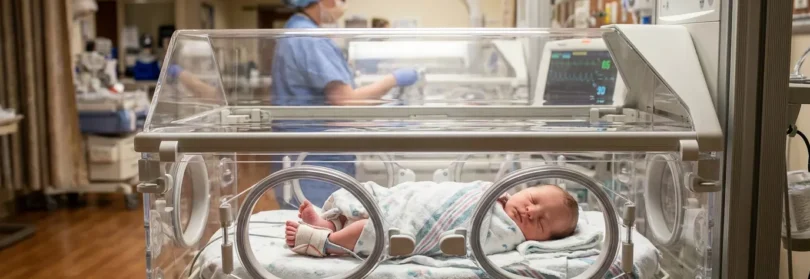
When Newborn Jaundice Turns Into Permanent Brain Damage
Key Takeaways: Kernicterus is permanent brain damage from dangerously high newborn bilirubin levels and may constitute medical malpractice in Houston when hospitals or pediatricians fail to test, monitor, treat, or arrange follow-up for jaundiced infants. Warning signs include deep yellowing, extreme lethargy, poor feeding, high-pitched cry, and arching of the neck and back, with potential long-term effects including athetoid cerebral palsy and hearing loss. Viable claims require proof that providers departed from accepted standards of care and that the departure caused injury, supported by qualified expert reports under Tex. Civ. Prac. & Rem. Code § 74.351, generally within 120 days. Non-economic damages are capped under § 74.301, while uncapped economic damages often drive case value.
Kernicterus is permanent brain damage caused by dangerously high bilirubin levels in a newborn’s bloodstream. When bilirubin builds up faster than an infant’s liver can clear it, the pigment crosses into brain tissue and damages cells controlling movement, hearing, and muscle tone. This condition is often preventable through routine bilirubin testing, phototherapy, and, in severe cases, exchange transfusion. When Houston hospitals or pediatricians fail to test, monitor, or treat jaundiced newborns, the resulting untreated newborn jaundice brain damage may support medical malpractice claims under Texas law.
If your child was diagnosed with kernicterus, cerebral palsy, or hearing loss after a hospital stay involving jaundice, the attorneys at Fibich, Leebron, Copeland & Briggs are prepared to investigate. Call 713-751-0025 or contact our Houston team today.

Understanding the Kernicterus Definition and How Bilirubin Injures the Brain
Kernicterus is the chronic, permanent stage of bilirubin encephalopathy, brain injury caused by excess bilirubin. While nearly every newborn experiences some jaundice that resolves without incident, danger arises when levels climb unchecked, particularly in premature infants, babies with blood-type incompatibility, infants with feeding difficulties, or newborns discharged before bilirubin peaks.
Kernicterus is categorized alongside other catastrophic newborn brain injuries, including hypoxic-ischemic encephalopathy, periventricular leukomalacia, and intracranial hemorrhage, framing it as potentially preventable neonatal brain damage rather than an unavoidable complication.
Kernicterus Symptoms Parents Should Never Ignore
Early warning signs often appear within the first days or weeks and can escalate quickly. Common kernicterus symptoms include:
- Deep yellowing of skin and whites of eyes, spreading toward legs and feet
- Extreme lethargy, difficulty waking, or poor feeding
- High-pitched, inconsolable cry
- Arching of neck and back
- Fever, vomiting, or abnormal muscle tone shifting between limp and rigid
Long-term consequences may include athetoid cerebral palsy, sensorineural hearing loss, vision abnormalities, and dental enamel defects. Many children require lifelong therapy, mobility equipment, communication devices, and attendant care.
💡 Pro Tip: Request complete nursery records, discharge summaries, feeding logs, and every bilirubin lab result with exact specimen draw times. Timing gaps between draws often reveal where monitoring broke down.
When Newborn Jaundice Negligence Becomes a Legal Claim
Poor outcomes alone do not establish liability under Texas law. Families must prove that providers deviated from accepted professional standards of care and that this deviation proximately caused the child’s injury. Both standard of care and causation ordinarily require qualified expert medical testimony.
Alleged breaches typically include: failing to order appropriate bilirubin testing, misdiagnosing jaundice severity, failing to monitor at-risk infants, providing improper or delayed treatment, and failing to arrange post-discharge follow-up. Each theory depends on medical records, nursing documentation, and clinical decision timelines.
Texas Law Imposes Newborn Screening Follow-Up Duties
Texas statutory law supports the argument that discharge follow-up is not optional. Under Tex. Health & Safety Code § 161.501(a)(1)(D), hospitals, birthing centers, physicians, nurse midwives, or midwives providing prenatal or delivery care must give parents resource pamphlets including "appropriate schedules for follow-up procedures for newborn screening."
The statute also addresses documentation. Tex. Health & Safety Code § 161.501(a)(3)-(4) directs providers to "document in the woman’s record" that required materials were received and "retain the documentation for at least five years." This newborn screening information requirement creates paper trails examined during Houston birth-injury investigations.
Chapter 74 Governs Every Texas Medical Malpractice Newborn Case
Health care liability claims in Texas, including infant brain damage claims, proceed under Chapter 74 of the Civil Practice and Remedies Code. This chapter addresses pre-suit notice under § 74.051, informed-consent theories under § 74.101, emergency care immunity under § 74.151, limitations under § 74.251, and damages caps under § 74.301. Families understanding the Texas medical liability statute framework early may better preserve their rights.
Section 74.251(a) generally requires suit within two years, and minors under age 12 must generally have suit filed by their 14th birthday; § 74.251(b) sets a 10-year statute of repose. Courts construe tolling and discovery-rule arguments narrowly and do not apply them automatically.
The Chapter 74 Expert Report Requirement
Kernicterus claims generally cannot proceed without qualified expert reports served early in litigation. Tex. Civ. Prac. & Rem. Code § 74.351(r)(6) defines expert reports as written reports providing fair summaries of opinions regarding "applicable standards of care, the manner in which care rendered failed to meet standards, and causal relationships between failures and claimed injuries, harm, or damages." Under § 74.351(a), reports must generally be served on each defendant within 120 days after that defendant files an answer. Failure typically results in dismissal with prejudice and awards of defendants’ attorney’s fees.
On causation, § 74.351(r)(5)(C) requires opinions from "physicians otherwise qualified to render opinions on such causal relationships under Texas Rules of Evidence." Reports must connect specific failures to specific brain injuries sustained.
💡 Pro Tip: Preserve photographs of your baby from the first week. Images showing progressive yellowing can corroborate what parents reported to nursing staff.
Emergency Care Immunity and Why It Rarely Shields Nursery Staff
Defendants sometimes invoke good-faith emergency care immunity, but its reach is limited. Under Tex. Civ. Prac. & Rem. Code § 74.151(a), persons administering emergency care in good faith are not liable in civil damages "unless acts are wilfully or wantonly negligent."
More significantly, § 74.151(b)(1) provides that the section does not apply to care administered "for or in expectation of remuneration." Paid treating physicians, nurses, and hospital staff managing newborn bilirubin levels generally may not rely on this immunity.
Damages in a Newborn Jaundice Brain Damage Texas Claim
Texas caps non-economic damages in health care liability claims, making economic damages the financial center of serious kernicterus cases. Under Tex. Civ. Prac. & Rem. Code § 74.301(a), non-economic damages against physicians and non-institutional health care providers are "limited to $250,000 for each claimant, regardless of the number of defendant physicians or health care providers." Separate caps apply to health care institutions under § 74.301(b) and (c).
| Defendant Category | Non-Economic Damages Cap (Per Claimant) |
|---|---|
| Physicians and non-institutional providers, § 74.301(a) | $250,000 total, regardless of number of defendants |
| Single health care institution, § 74.301(b) | $250,000 |
| Multiple health care institutions combined, § 74.301(c) | $500,000 |
Economic damages are generally not subject to these caps. Potentially recoverable categories include past and future medical expenses, therapies, surgeries, assistive devices, mobility equipment, in-home attendant care, home and vehicle modifications, and lost earning capacity. For children with permanent bilirubin encephalopathy, properly documented life care plans and vocational economic analyses may represent the difference between nominal recoveries and those accounting for decades of care. Families weighing whether to sue for birth injuries caused by negligence should understand that these projections require early development.
Institutional and Multi-Party Liability
Kernicterus cases frequently involve multiple potentially negligent actors. Delivery hospitals, nursery nursing staff, pediatric groups, laboratories, and discharging physicians may each have contributed to missed diagnoses. Identifying every potentially responsible entity matters for both causation proof and because institutional caps may apply separately from caps applicable to physicians.
Hospital systems and their insurers often defend these claims aggressively, sometimes arguing injuries stemmed from unrelated genetic or metabolic conditions, or asserting proportionate responsibility defenses under Chapter 33. Countering those defenses generally requires disciplined record review, qualified medical opinion, and willingness to try cases.
Frequently Asked Questions
1. How long do Texas families have to file a kernicterus claim?
Health care liability claims are generally subject to two-year deadlines under § 74.251, with special rules providing that children under 12 must generally have suits filed by their 14th birthday, plus a 10-year statute of repose. Courts interpret tolling exceptions narrowly. Prompt consultation is advisable.
2. What if the hospital says my baby’s jaundice was normal?
Physiologic jaundice is common, but the legal question is whether providers met standards of care in testing, monitoring, and responding to rising bilirubin levels. Documentation showing no bilirubin was measured, critical values were not acted upon, or no follow-up was scheduled may support hospital jaundice negligence claims in Houston.
3. Do I need medical proof before contacting an attorney?
No. Attorneys typically obtain and review complete medical records as part of initial investigations. Bringing discharge paperwork and any lab results can help reviews move faster.
4. Can I recover if my child has cerebral palsy but no formal kernicterus diagnosis?
Possibly. Athetoid cerebral palsy and sensorineural hearing loss are recognized potential consequences of bilirubin toxicity, and underlying causes are sometimes established retrospectively through record review and imaging. Claim viability depends on documented bilirubin history and qualified medical opinion establishing both breach and causation.
5. Are non-economic damage caps the limit of what my family can recover?
No. Statutory caps generally apply only to non-economic damages such as pain and suffering. Economic damages, including future medical care, attendant care, and lost earning capacity, are generally not capped and may constitute the majority of serious infant brain damage claims in Texas.
Holding Houston Providers Accountable for a Preventable Injury
Kernicterus represents one of the more preventable catastrophic outcomes in newborn medicine. When bilirubin is measured, tracked, and treated appropriately, many infants avoid lasting injury. When it is not, families may face decades of therapy costs, equipment needs, attendant care, and diminished earning capacity for children who deserved better. Texas law may provide paths to accountability, but it generally demands early action, disciplined record development, and qualified medical support satisfying Chapter 74.
If your family is confronting the aftermath of untreated newborn jaundice brain damage, the trial attorneys at Fibich, Leebron, Copeland & Briggs are prepared to investigate the conduct of every provider involved. Speak with a kernicterus malpractice Houston attorney by calling 713-751-0025 or request a case evaluation now.
Disclaimer: This content is for informational purposes only and is not legal advice. Every case is unique, and results may vary. Consult an attorney about your specific circumstances.