
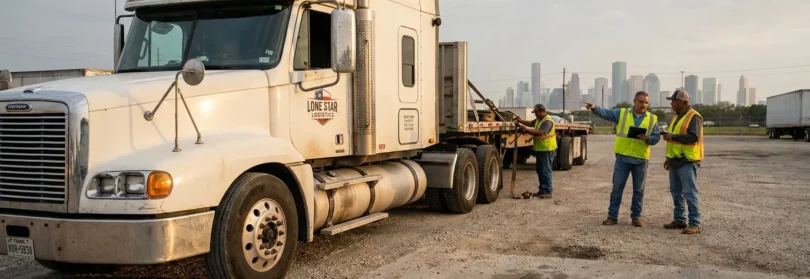
Holding the Middlemen Accountable After a Brokered-Load Wreck in Houston
Key Takeaways: Freight brokers may be sued after a Houston 18-wheeler crash, typically under negligent motor carrier selection claims alleging failure to vet the carrier’s safety history, authority, or insurance. Brokers have long argued the Federal Aviation Administration Authorization Act (49 U.S.C. § 14501(c)(1)) preempts such claims, but the U.S. Supreme Court unanimously resolved the former circuit split in Montgomery v. Caribe Transport II, LLC (May 14, 2026), holding that the statute’s safety-regulation exception under 49 U.S.C. § 14501(c)(2)(A) preserves such claims from preemption. Under Tex. Transp. Code § 646.002, brokers registered as motor carriers under Chapter 643 or holding federal permits are exempt from Chapter 646, potentially shifting liability theories. Tex. Civ. Prac. & Rem. Code § 16.003(a) generally sets a two-year deadline for personal injury claims, while § 16.003(b) starts the wrongful death clock on the date of death. Texas applies a specialized commercial trucking framework in Chapter 72, including § 72.054, which can limit certain theories against employers, and § 72.052, which permits bifurcated trials. Broker-carrier contracts, vetting records, ELD data, and maintenance files can be decisive, and preservation letters should be sent early.
Yes, in some cases a freight broker may be named as a defendant after a catastrophic 18-wheeler collision in Houston, though outcomes depend on whether federal preemption defenses can be overcome, the broker’s regulatory status, its role in selecting the motor carrier, and whether suit is filed within the applicable limitations period. Freight brokers don’t drive trucks, but they decide which carriers haul loads across I-45, the 610 Loop, and the Ship Channel corridor. When a broker hands a load to a carrier with a troubling safety record, the broker’s decision-making may become a legitimate target of investigation.
If you or someone you love suffered life-altering injuries in a brokered load crash, the trial team at Fibich, Leebron, Copeland & Briggs is prepared to trace the chain of corporate responsibility from the driver back to the broker. Call 832-925-3015 or contact us now to discuss what happened and how evidence should be preserved.

Why Freight Broker Liability in a Truck Accident Case Matters
A freight broker sits between the shipper and the trucking company, arranging transportation without owning the tractor-trailer or employing the driver. That arrangement can create separation that insurers may exploit after a wreck, arguing the broker had no control over the crash. Plaintiffs often focus on what the broker knew or should have known about the carrier before entrusting it with an 80,000-pound vehicle.
The theory most commonly asserted is negligent motor carrier selection. In these claims, the injured party alleges the broker failed to conduct reasonable diligence into the carrier’s safety history, insurance, authority, or compliance record. Brokers have historically responded that such claims are preempted because they relate to broker "services," but the U.S. Supreme Court unanimously held in Montgomery v. Caribe Transport II, LLC (May 14, 2026) that the FAAAA’s safety-regulation exception under 49 U.S.C. § 14501(c)(2)(A) preserves such state-law claims from preemption.
How Texas Classifies Brokers Versus Motor Carriers
Texas law draws a meaningful distinction between freight brokers and motor carriers, and that classification may shape who can be named in a lawsuit. Under the motor transportation broker statute, Tex. Transp. Code § 646.002 provides that Chapter 646 "does not apply to a motor transportation broker who: (1) is registered as a motor carrier under Chapter 643; or (2) holds a permit issued under Subtitle IV, Title 49, United States Code."
That carve-out can matter considerably. A company marketing itself as a broker may also hold federal operating authority, which can open the door to carrier-based liability theories. Determining a defendant’s exact regulatory posture is often one of the first investigative steps in a serious Houston trucking lawsuit.
Broker Negligence in Houston Cases Rarely Stands Alone
Serious 18-wheeler crashes often involve several potentially responsible entities at once. The driver, the motor carrier, the trailer owner, a maintenance contractor, a shipper who loaded the cargo, and the broker may each bear a share of fault. Understanding multi-party liability in truck crashes can be essential when catastrophic damages exceed a single carrier’s insurance limits.
The Filing Deadline That Controls Your 18-Wheeler Injury Claim
A limitations period is a legal rule that generally bars a claim once a set amount of time has passed after an injury, and the length varies by jurisdiction and claim type. Texas limitations periods are codified in Chapter 16 of the Civil Practice and Remedies Code. Tex. Civ. Prac. & Rem. Code § 16.003(a) requires suit for personal injury to be brought "not later than two years after the day the cause of action accrues," which generally includes negligent hiring or negligent selection claims asserted against a freight broker.
Section 16.003(a) includes exceptions referenced in Sections 16.010, 16.0031, and 16.0045. Other provisions, such as tolling for legal disability under § 16.001, may also affect the deadline. Courts interpret exceptions narrowly, and nothing about an extension is automatic. In Texas, a claim ordinarily accrues when the wrongful act causes injury, and the discovery rule is a limited exception applied only where the injury is inherently undiscoverable.
In fatal crashes, the wrongful death clock is also generally two years, and § 16.003(b) provides that "The cause of action accrues on the death of the injured person." That distinction can be significant when a loved one survives for weeks in a Houston trauma unit before passing. A survival claim for the decedent’s own pre-death injuries generally accrues at the time of injury rather than at death.
| Claim Type | General Texas Deadline | Authority |
|---|---|---|
| Personal injury from a truck crash | 2 years from accrual | § 16.003(a) |
| Wrongful death | 2 years from date of death | § 16.003(b) |
| Property damage (vehicle destroyed) | 2 years from the accident | § 16.003(a) |
| Fraud, breach of fiduciary duty | 4 years | § 16.004 |
| Breach of contract and other residual claims | 4 years | § 16.051 |
Non-injury theories can run on a different timeline than the injury claim itself. Because the analysis is fact-dependent, injured parties should confirm the exact applicable deadline with counsel rather than relying on a general rule.
💡 Pro Tip: Send preservation letters early. Broker-carrier agreements, load confirmations, rate sheets, and carrier vetting records are often maintained only for limited periods and can be central to proving negligent carrier selection.
Texas Statutes Built Specifically for Commercial Trucking Cases
Texas has enacted a specialized liability framework for commercial motor vehicle collisions rather than leaving them to ordinary negligence rules alone. Tex. Civ. Prac. & Rem. Code § 72.054 generally provides that when a defendant stipulates that the employee was acting within the scope of employment, the plaintiff ordinarily may not proceed in the first phase on separate direct-negligence theories against the employer, such as negligent hiring or entrustment, absent a claim for exemplary damages.
Defendants also hold a procedural tool that can change how these cases are tried. Under the commercial vehicle trial statute, § 72.052 requires, on a defendant’s timely motion, a bifurcated trial in certain commercial motor vehicle collision actions, with compensatory damages decided in the first phase and exemplary damages in the second. A first-phase finding that the employee was negligent can support pursuing direct-liability theories against the employer in the second phase.
What This Means for Building a Case Against a Broker
Bifurcation tends to reward preparation and punish shortcuts. Because punitive exposure may be deferred to a second phase, plaintiffs must construct the compensatory case with precision while preserving evidence needed to prove corporate indifference later.
Evidence that frequently drives these claims includes:
- Broker-carrier contracts, load confirmations, and rate agreements
- The carrier’s safety ratings, crash history, and insurance filings at the time of selection
- Internal broker vetting policies and whether they were actually followed
- Electronic logging device data, black-box downloads, and hours-of-service records
- Maintenance and inspection files for the tractor and trailer
Damages in Catastrophic Brokered-Load Collisions
The financial reality after a severe 18-wheeler wreck often extends far beyond the initial hospitalization. Spinal cord injuries, traumatic brain injuries, amputations, and severe burns may require lifetime attendant care, home modifications, and repeated surgeries. Anchoring the claim in credible future medical care projections and lost earning capacity analysis can separate a serious case from a nominal one.
Insurers for brokers and carriers frequently move quickly to limit exposure. They may dispute causation, shift fault to the injured driver, invoke federal preemption, or argue the broker owed no duty. Texas also applies proportionate responsibility under Chapter 33, which can reduce or bar recovery depending on fault allocated to each party. A freight broker liability truck accident lawyer can evaluate whether the facts support pursuing the broker alongside the carrier and driver.
Frequently Asked Questions
1. Can I sue a freight broker if the trucking company has insurance?
Potentially. When catastrophic damages exceed a carrier’s available coverage, adding a broker with an independent negligence theory may expand potential recovery sources. Following the U.S. Supreme Court’s decision in Montgomery v. Caribe Transport II, LLC (May 14, 2026), FAAAA preemption arguments that previously created uncertainty for such claims have been resolved in favor of preserving state-law negligent-selection claims.
2. How long do I have to sue a freight broker in Texas?
Negligence-based claims generally fall under the two-year personal injury deadline in Tex. Civ. Prac. & Rem. Code § 16.003(a). Certain non-injury theories may carry a four-year period under § 16.004, and exceptions may apply, so the deadline should be confirmed with counsel promptly.
3. Does it matter whether the broker also holds carrier authority?
Yes, significantly. Under Tex. Transp. Code § 646.002, Chapter 646 does not apply to a motor transportation broker registered as a motor carrier under Chapter 643 or holding a federal permit, and a defendant that operates as a carrier on a given load may face carrier-based liability theories.
4. What if my family member died weeks after the collision?
The wrongful death limitations period is generally two years, and under § 16.003(b) the cause of action accrues on the death of the injured person rather than the crash date. A related survival claim may accrue earlier.
5. Will my case go to trial?
That depends on the facts, the defendants’ positions, and the strength of evidence. Because § 72.052 permits bifurcation on a defendant’s motion in certain commercial vehicle cases, preparing every serious claim as though it may be tried is generally the sound approach.
Protecting Your Family’s Future After a Devastating Truck Crash
Freight brokers are not automatically immune from accountability after a Houston 18-wheeler crash. Following the U.S. Supreme Court’s unanimous decision in Montgomery v. Caribe Transport II, LLC (May 14, 2026), state-law negligent motor carrier selection claims are preserved from FAAAA preemption under the statute’s safety-regulation exception. Where the evidence suggests careless motor carrier selection, and where the claim is brought within the applicable limitations period under Chapter 16, a broker may potentially be named alongside the driver and the trucking company.
If your family is confronting permanent disability, mounting medical bills, and lost income after a catastrophic collision, the attorneys at Fibich, Leebron, Copeland & Briggs are ready to investigate every potentially responsible party. Reach the firm at 832-925-3015 or request a case review today.
Disclaimer: This content is for informational purposes only and is not legal advice. Every case is unique, and results may vary. Consult an attorney about your specific circumstances.