
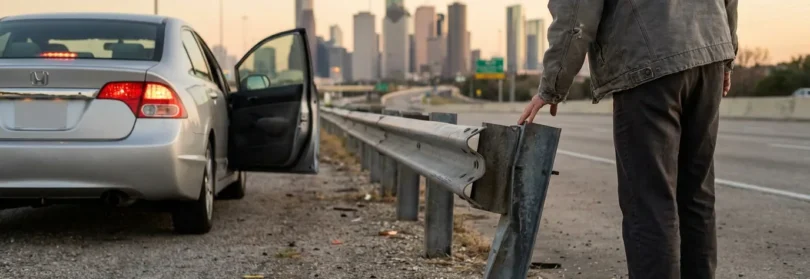
Why Evidence Decides the Outcome of a Houston Guardrail Injury Claim
Key Takeaways: Evidence preservation after a Houston guardrail crash often determines whether victims receive full compensation or face a denied claim. Critical first steps include documenting the scene immediately, photographing the guardrail, vehicle damage before repairs, skid marks, and roadway conditions. Official records including police reports, municipal repair-shop filings, and TxDOT crash records strengthen proof of causation and should be requested promptly. Medical documentation and a personal injury journal connect the crash to compensable harm. Texas law supports victims through preservation duties imposed on opposing parties in certain contexts and, in commercial vehicle cases, a statutory presumption favoring authenticated photographs. Speed is essential since surveillance footage can be overwritten within days and personal injury suits must generally be filed within two years, with government claims requiring even earlier notice.
When a vehicle strikes a highway guardrail in Houston, evidence often determines whether victims receive full compensation or face claim denial. Guardrails are engineered to absorb impact and shield occupants, so when one spears a vehicle, fails to deflect, or was missing entirely, injuries can be catastrophic, including spinal cord damage, traumatic brain injury, amputation, or death. Quick evidence preservation is essential because liable parties such as manufacturers, contractors, maintenance crews, and government units have strong incentives to dispute fault. This guide explains practical steps and Texas legal rules that protect your ability to hold defendants accountable.
📌 Act now with a team that takes serious guardrail cases seriously. The attorneys at Fibich, Leebron, Copeland & Briggs understand how quickly critical proof disappears after a high-impact crash. Call 832-925-3015 or reach out through our confidential case review page to discuss how to protect your claim today.

The First Hours: Capturing Physical Proof at the Scene
The crash scene begins degrading the moment traffic resumes, making immediate documentation irreplaceable. Debris is swept away, vehicles are towed, and damaged guardrail sections are sometimes repaired within days. If you or a family member is physically able, photographing the environment before it changes preserves how the collision unfolded.
Photographs should capture far more than vehicle damage. You should record vehicle positions, damage to each car, debris, skid marks, traffic signs and signals, lighting, and weather conditions. For guardrail cases, document the rail itself: the end terminal, how the rail bent or penetrated the vehicle, rust, missing bolts, and signs of prior damage. Strong photos can later anchor expert reconstruction.
Prioritize these evidence categories:
- The guardrail end terminal, posts, and any rail segment that entered the passenger compartment
- Skid marks, gouges, and debris showing the vehicle’s path and impact angle
- Roadway conditions, signage, lighting, and weather
- Vehicle damage from multiple angles before repairs begin
💡 Pro Tip: Photograph vehicle damage before repairs. Once body shops begin work, physical evidence of impact severity can be permanently lost, proof often central to establishing how the guardrail failed.
Official Records That Strengthen Guardrail Defect Evidence in Texas
Police reports and official documents form the backbone of guardrail injury documentation. An officer’s report typically contains date, time, location, driver information, and an accident scene diagram valuable for reconstructing the angle and speed of impact.
Texas law generates official records beyond standard crash reports. Under Texas Transportation Code § 550.067(a)-(c), municipalities like Houston may require crash operators to file reports with designated departments and may require repair shops to report vehicles brought in within 24 hours. In fatal cases, § 550.081(b)-(d) requires medical examiners or justices of the peace to submit written reports to TxDOT’s crash records bureau in Austin, including toxicological results.
These statewide records can become difficult to obtain once archived. Victims should request copies promptly, as reports filed with TxDOT form part of a critical statewide database for proving causation. Gathering this guardrail defect evidence early also helps identify all potentially responsible parties before deadlines arrive.
💡 Pro Tip: Ask whether the tow yard or repair facility filed a municipal report. That filing can independently confirm vehicle damage extent if insurers later dispute it.
Medical Documentation and the Human Cost of Catastrophic Injuries
Medical records translate violent guardrail crashes into measurable, compensable harm. Catastrophic injuries frequently require emergency surgery, extended hospitalization, rehabilitation, and lifelong care. Thorough records, including ER documentation, follow-up notes, and diagnostic imaging, connect the collision to injuries and support claims for lost wages and future medical care.
Consistency in treatment matters as much as the records themselves. Insurance companies may question treatment gaps, so maintaining complete medical history is critical. Beyond clinical files, keeping a personal journal helps prove non-economic damages by documenting pain levels, emotional distress, and daily inconveniences caused by injuries.
💡 Pro Tip: Keep a dated log of missed workdays, canceled plans, and tasks you can no longer perform. Contemporaneous records often carry more weight than testimony reconstructed months later.
How Texas Law Protects, and Limits, Your Guardrail Accident Evidence
Texas statutes empower victims and impose preservation duties on opposing parties in certain contexts. In civil actions involving commercial motor vehicles, Texas Civil Practice and Remedies Code § 72.055 presumes properly authenticated photographs or videos of vehicles or objects involved in collisions are admissible, even when addressing damage or injury severity. While this specific presumption applies only to commercial vehicle cases, crash scene images and guardrail failure proof can stand as powerful evidence when properly authenticated under the Texas Rules of Evidence.
Opposing parties often have a duty to preserve evidence once on notice under Texas discovery rules, spoliation law, or other statutes. While Texas Civil Practice and Remedies Code § 138.004(b)-(c) contains preservation and sanction provisions, those provisions operate within Chapter 138’s narrow statutory context and do not create a general preservation regime for guardrail cases. In practice, issuing formal written preservation notice to defendants like TxDOT, contractors, or manufacturers helps trigger obligations to preserve maintenance logs, inspection records, and design files.
Government liability for guardrails involves narrow but important exceptions. Under the Texas Tort Claims Act, governmental units are generally immune for discretionary decisions not to place warning devices, but § 101.060(a) allows liability when the absence, condition, or malfunction of signs, signals, or warning devices isn’t corrected within reasonable time after notice. Section 101.060(c) provides this immunity doesn’t apply to special defects like excavations or roadway obstructions, severely damaged or missing guardrails may qualify. Whether a particular condition is a "special defect" is decided by courts on specific facts, making evidence development crucial. Our firm explains the broader framework in this discussion of proving government negligence in guardrail cases.
Why Speed Matters: Deadlines and Disappearing Footage
Texas deadlines are strict. Under Texas Civil Practice and Remedies Code § 16.003, personal injury lawsuits must generally be filed within two years of injury, and § 16.070(a) voids any stipulation, contract, or agreement that establishes a limitations period shorter than two years. While limited tolling or discovery exceptions can apply in certain circumstances, Texas courts interpret them narrowly, never assume extensions apply automatically.
Surveillance evidence vanishes far faster than legal deadlines. Dashcam footage and recordings from nearby businesses or homes should be requested promptly, as many systems overwrite recordings within days or weeks. Memories fade and witnesses relocate, making immediate evidence preservation both practical and legally strategic.
💡 Pro Tip: Government tort claims often require written notice well before the two-year civil deadline. These administrative requirements are separate from lawsuit deadlines, missing either can bar recovery.
Evidence Preservation Timeline at a Glance
| Evidence Type | Why It Matters | Typical Risk Window |
|---|---|---|
| Scene and guardrail photos | Shows impact angle and defect | Hours to days |
| Surveillance/dashcam footage | Captures the collision | Days to weeks |
| Vehicle damage (pre-repair) | Proves impact severity | Before repairs begin |
| Official crash/TxDOT records | Establishes causation | Subject to archiving |
| Civil lawsuit filing | Preserves the claim | Generally two years |
Frequently Asked Questions
-
What evidence is most important after a guardrail crash in Houston?
The strongest cases combine physical, official, and medical proof. Scene photographs, the damaged guardrail, police reports, TxDOT records, surveillance footage, and complete medical documentation work together to establish defect, causation, and damages.
-
How long do I have to file a guardrail injury lawsuit in Texas?
Personal injury suits face a two-year deadline under Texas Civil Practice and Remedies Code § 16.003. Government claims may require earlier written notice, and limited exceptions can apply in narrow circumstances. Prompt legal review is wise.
-
Can my crash photos be used as evidence in court?
Yes, when properly authenticated. Photographs are generally admissible once authenticated under Texas Rules of Evidence; in commercial motor vehicle cases, § 72.055 adds an express presumption of admissibility for such images.
-
Who can be held responsible in a guardrail failure case?
Liability may extend to several parties. Depending on facts, manufacturers, installation contractors, maintenance providers, or governmental units may share responsibility. Establishing government fault requires showing notice and failure to correct within reasonable time under the Texas Tort Claims Act.
-
What should I do if the guardrail was already repaired?
Preservation duties and prior records can still help. Parties often have a duty to preserve relevant materials once on notice under discovery rules and spoliation doctrines, and inspection logs, maintenance records, and earlier photographs may document defects. Issuing written preservation notice quickly is critical.
Protecting Your Right to Full Accountability
Preserving evidence after a Houston guardrail crash is an ongoing strategy beginning at the scene and continuing through litigation. From scene photographs and medical records to official TxDOT reports and statutory preservation demands, each piece supports proving defect, causation, and catastrophic harm. Texas law provides meaningful tools, including preservation duties on opposing parties in certain contexts and, in commercial-vehicle cases, admissibility presumptions for photos, but these protections reward those who act quickly and methodically. Because guardrail cases involve complex, multi-party liability and strict deadlines, guidance from a seasoned Houston guardrail accident lawyer can make a decisive difference.
📌 Do not let critical evidence slip away while insurers and contractors build their defense. The trial-focused team at Fibich, Leebron, Copeland & Briggs is respected for handling serious, high-stakes injury and wrongful death cases across Houston and South Texas. Call 832-925-3015 or contact us through our secure consultation form to protect your rights and pursue the full accountability your family deserves.