
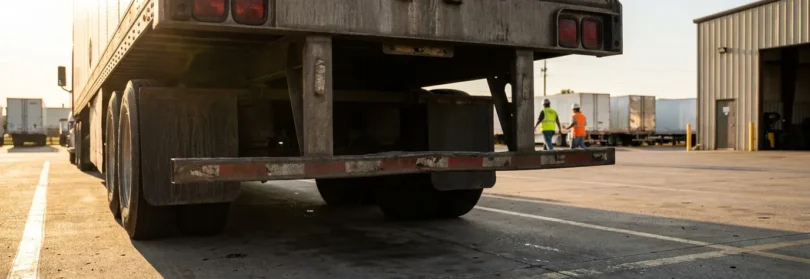
When a Trailer’s Rear Guard Fails, the Consequences Are Catastrophic
Key Takeaways: A truck underride guard failure claim in Houston is filed when a passenger vehicle slides beneath a commercial trailer because the rear impact guard broke, bent, corroded, or was inadequate. Because the car’s crumple zone is bypassed, these crashes commonly cause traumatic brain injuries, spinal damage, amputations, and death, generating lifetime care and lost-income losses. Cases often combine negligence against the driver and carrier with design defect, manufacturing defect, or negligent maintenance claims against trailer makers, guard manufacturers, and repair vendors. Texas Chapter 33 allows a jury to apportion fault among all parties, bars recovery if the claimant is more than 50 percent responsible, and may impose joint and several liability on a defendant found more than 50 percent responsible. Claims generally must be filed within two years under Tex. Civ. Prac. & Rem. Code § 16.003, while product theories may face a 15-year statute of repose. Preserving the trailer, guard, maintenance files, and electronic data before the trailer returns to service can determine whether the claim can be proven.
A truck underride guard failure claim is brought when a passenger vehicle slides beneath a commercial trailer because the rear impact guard broke, bent, corroded, or was inadequate for the forces involved. Federal regulations require rear impact guards on most trailers under 49 C.F.R. § 393.86, but do not mandate side guards. When the guard fails, the trailer bed may enter the passenger compartment at windshield height, bypassing safety features entirely. Under Texas law, such claims may combine negligence theories against the driver and carrier with product-defect and maintenance theories against the trailer manufacturer, guard manufacturer, or repair vendor.
If your family is facing permanent disability, lifetime medical care, or loss of a loved one after a Houston underride collision, the team at Fibich, Leebron, Copeland & Briggs is prepared to investigate immediately. Call 832-925-3015 or reach out to our Houston trial team to discuss preserving critical evidence.
Why Truck Underride Guard Failure Accidents Devastate Occupants
Underride crashes remove the single most important safety feature in a passenger vehicle: the crumple zone. In a typical rear-end collision, the front of the car absorbs and dissipates energy before the cabin deforms. In an underride injury, the car passes under the trailer, the guard collapses or shears off, and the trailer’s structure may strike occupants directly. Survivors frequently face traumatic brain injuries, cervical spine damage, amputations, and disfigurement.
The financial aftermath compounds the physical harm. Families may confront decades of attendant care, home modification, adaptive equipment, and permanent loss of a wage earner’s future income. Damages analysis requires life care planners and economists, not simply medical bills. These matters demand careful case selection and a trial-ready approach rather than rushed resolution with a carrier’s first adjuster.
The Legal Theories Behind an Underride Guard Claim
Many serious underride cases proceed on multiple theories at once. A rear impact guard claim may rest on negligent maintenance, negligent inspection, unreasonably dangerous design, manufacturing defect, or failure to warn about known guard limitations. Design-defect claims in Texas carry statutory proof requirements under Tex. Civ. Prac. & Rem. Code § 82.005. The available theories depend heavily on physical evidence that can disappear quickly once a trailer returns to service.
Negligence Against the Driver and Motor Carrier
Carrier liability in Texas is shaped by a specific statutory framework. Under Texas Civil Practice and Remedies Code § 72.054(a), an employer defendant’s liability for damages caused by ordinary negligence of a person operating the defendant’s commercial motor vehicle is based only on respondeat superior if the defendant stipulates that the operator was its employee acting within the scope of employment. This provision addresses ordinary negligence; Chapter 72 does not bar a properly supported claim for exemplary damages. Reviewing the full text of the commercial vehicle liability statute is a useful starting point for understanding these pleadings.
Product Defect Against the Trailer or Guard Manufacturer
An underride guard defect claim examines whether the guard performed as a reasonably safe design should. Texas also imposes a statute of repose that may cut off product-liability suits a fixed number of years after sale. Under Texas Civil Practice and Remedies Code § 16.012(b), a claimant generally must commence a products-liability action within 15 years after the date of sale by the defendant. Express exceptions exist where the manufacturer warranted a longer useful safe life under § 16.012(c), and § 16.012(d) addresses claims involving latent diseases as an exception to the repose period. Section 16.012(d-1) is a savings clause providing that the repose period does not reduce a limitations period for a latent disease cause of action under § 16.012(d) that accrues before the repose period expires.
Maintenance, Inspection, and Corrosion Failures
Rear impact guards can degrade, and degraded guards may fail at lower speeds than new ones. Corrosion, prior collision damage, improper welds, and non-conforming aftermarket repairs are recurring findings in underride investigations. Federal rules require motor carriers to systematically inspect, repair, and maintain equipment under 49 C.F.R. Part 396, which can supply the standard of care. Establishing this requires the trailer’s maintenance file, inspection reports, and preservation of the guard itself before it is scrapped or repaired.
💡 Pro Tip: Send a written evidence preservation demand as early as possible identifying the trailer by VIN, the rear impact guard, maintenance records, and electronic control module data. Once a trailer is repaired, the strongest physical proof in a Texas truck underride lawsuit may be gone permanently.
How Texas Divides Fault in a Multi-Defendant Underride Case
Texas apportions responsibility among everyone whose conduct contributed to the harm. Chapter 33 of the Texas Civil Practice and Remedies Code applies to negligence and products liability actions, so a jury may assign percentages among the truck driver, motor carrier, trailer manufacturer, maintenance provider, and injured motorist. Under Texas Civil Practice and Remedies Code § 33.001, a claimant is barred from recovery if the claimant’s percentage of responsibility is greater than 50 percent. If the claimant’s share is 50 percent or less, § 33.012(a) requires the award to be reduced by that percentage.
Allocation determines who actually pays. Under Texas Civil Practice and Remedies Code § 33.013(a), a liable defendant is generally liable only for the percentage of damages equal to that defendant’s percentage of responsibility. A critical exception exists: under § 33.013(b)(1), joint and several liability may attach when the percentage of responsibility attributed to a defendant is greater than 50 percent, which can help a family when a co-defendant is insolvent or underinsured.
Chapter 33 also arms defendants with procedural tools. Section 33.004 permits designation of responsible third parties on timely motion, and trucking defendants often designate absent parties to shift blame. The proportionate responsibility rules may benefit plaintiffs who identify every responsible entity early. Understanding multi-party liability in a Houston semi-truck crash can be the difference between full accountability and partial recovery.
| Potential Defendant | Typical Theory | Key Evidence |
|---|---|---|
| Truck driver | Ordinary negligence | ELD data, dashcam, statements |
| Motor carrier | Respondeat superior, maintenance failures | Inspection files, hiring records |
| Trailer manufacturer | Design or manufacturing defect | Guard specifications, testing data |
| Repair or maintenance vendor | Negligent repair | Work orders, weld records |
| Shipper or loader | Loading and cargo practices | Bills of lading, load documentation |
Filing Deadlines That Can End a Claim Before It Starts
Missing the limitations deadline can be fatal to a claim. A Houston truck underride injury claim must generally be filed within two years of the crash under Tex. Civ. Prac. & Rem. Code § 16.003(a). When an underride collision is fatal, the family’s wrongful death claim generally carries a two-year deadline running from the date of death under § 16.003(b). Property damage generally falls within the same two-year window, and shorter deadlines may apply when a governmental entity is involved.
Tolling arguments exist, but Texas courts have generally interpreted them narrowly. Statutory tolling for minors and persons of unsound mind under § 16.001 is one recognized exception, but relying on a possible extension is a serious risk. Practical steps that may protect a claim include:
- Preserving the trailer, rear impact guard, and all crash debris before repair or salvage
- Obtaining maintenance, inspection, and prior-repair records for the specific trailer
- Documenting medical treatment, work restrictions, and projected future care needs
- Identifying every corporate entity: carrier, owner, lessor, manufacturer, shipper
- Consulting counsel well before the two-year mark, since repose and defect theories may run differently
Frequently Asked Questions
1. How long do I have to file an underride claim in Texas?
Generally two years from the date of the collision for personal injury claims, and two years from the date of death for wrongful death claims, under Tex. Civ. Prac. & Rem. Code § 16.003. Product-defect theories may also face the 15-year repose period in § 16.012.
2. Can I recover if I was partially at fault for the crash?
Possibly. Under Texas Civil Practice and Remedies Code § 33.001, recovery is barred only if your percentage of responsibility exceeds 50 percent. At or below that threshold, recoverable damages are reduced proportionally under § 33.012.
3. Who can be held responsible in an underride guard failure case?
Potentially several parties at once, including the driver, motor carrier, trailer or guard manufacturer, maintenance vendor, and sometimes the shipper. Chapter 33 permits fault to be apportioned among all of them, and a defendant found more than 50 percent responsible may face joint and several liability.
4. What evidence matters most in these cases?
The guard itself, the trailer’s maintenance history, and reconstruction data. Guard specifications, federal compliance and inspection records, weld and corrosion evidence, prior repair orders, and electronic data from the tractor help determine whether a defect or maintenance theory can be proven.
5. Does a defective guard claim differ from a negligence claim?
Yes. A defect claim targets the product’s design or manufacture, is governed in part by Chapter 82, and may implicate different defendants, different proof, and different time limits than a negligence claim against the driver or carrier. Many serious cases plead both.
Holding Every Responsible Company Accountable
Underride collisions produce some of the most severe injuries in commercial trucking, and the legal path forward is rarely simple. Between respondeat superior stipulations under § 72.054, proportionate responsibility under Chapter 33, and the two-year window under § 16.003, the outcome may depend on decisions made in the first weeks after the crash. Families who move quickly to preserve evidence may preserve their leverage as well.
If you are searching for a truck underride guard failure accidents lawyer after a catastrophic truck crash, the trial attorneys at Fibich, Leebron, Copeland & Briggs are ready to evaluate your case. Call 832-925-3015 or start your case review today with our Houston truck accident team.
Disclaimer: This content is for informational purposes only and is not legal advice. Every case is unique, and results may vary. Consult an attorney about your specific circumstances.