
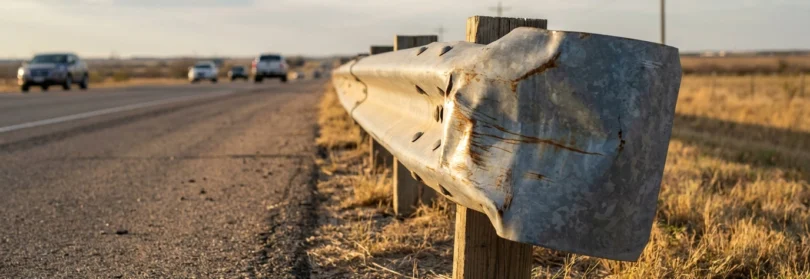
When Guardrails Fail: The Devastating Injuries Houston Drivers Face
A guardrail that works as designed redirects an errant vehicle, allowing it to continue at reduced speed in its original direction of travel. But when a guardrail is defective, the consequences can be catastrophic, turning a survivable roadway departure into a life-altering event involving penetration injuries, spinal cord damage, traumatic amputations, or death. Traffic crashes in 2024 caused an estimated $1.83 trillion in societal harm, with defective guardrail systems contributing to some of the most severe outcomes. For Houston families dealing with permanent disability and mounting medical bills after a guardrail failure, understanding what went wrong and who bears responsibility is essential to accountability.
If you or a loved one suffered a serious injury in a Houston guardrail crash, Fibich, Leebron, Copeland & Briggs can help you evaluate your legal options. Call 832-925-3015 or contact us today to discuss your case.

How Defective Guardrails Cause Catastrophic Injuries in Houston
Guardrails fail in specific, well-documented ways, and each failure mode produces distinct injury patterns. According to TxDOT’s Roadway Design Manual, guard fence is engineered to redirect vehicles rather than stop them abruptly. When that design intent breaks down due to defects in installation, maintenance, or component integrity, vehicle occupants face forces the human body was never meant to absorb.
An untreated or improperly terminated guardrail end represents one of the most dangerous defect scenarios on Houston roadways. An untreated guard fence can stop a vehicle abruptly and penetrate the passenger compartment, causing guardrail spearing that often results in impalement of the driver or front-seat passenger.
Guardrail Spearing and Penetration Injuries
Spearing occurs when a W-beam rail pierces through a vehicle’s windshield, firewall, or floorboard during impact with an exposed guardrail end. Victims may suffer massive internal organ damage, traumatic brain injuries, or limb loss, requiring years of surgical intervention, rehabilitation, and long-term care.
Vaulting, Underride, and Secondary Impact Injuries
When guardrail height deviates from engineering standards, vehicles may vault over or underride the barrier entirely. TxDOT standards specify corrective action when rail height varies more than 3 inches above or below the 31-inch standard. Pavement overlays on Houston highways frequently raise the road surface without corresponding guardrail adjustments. Vaulting sends vehicles into the hazard the guardrail was supposed to shield, while underride can shear off a vehicle’s roof.
💡 Pro Tip: Photograph the guardrail, end terminal, and road surface as soon as safely possible. Pavement height relative to the rail can be critical evidence that may be repaired before your claim is filed.
Common Injury Types From Houston Guardrail Failures
Defective guardrails produce severe injuries, reflecting the high-energy nature of highway-speed collisions. Below is a summary of the most common catastrophic guardrail injuries:
| Injury Category | How It Occurs | Long-Term Impact |
|---|---|---|
| Spinal cord injuries and paralysis | Abrupt deceleration or rail penetration | Permanent disability, lifetime care costs |
| Traumatic brain injuries | Vaulting into fixed objects, secondary impacts | Cognitive impairment, lost earning capacity |
| Traumatic amputation | Rail penetration through passenger compartment | Prosthetics, vocational rehabilitation |
| Internal organ damage | Impalement or blunt force from guardrail components | Multiple surgeries, chronic medical needs |
| Severe burns | Post-crash fuel ignition after guardrail traps vehicle | Disfigurement, extensive reconstructive surgery |
| Wrongful death | Any failure mode at sufficient speed | Loss of household income, funeral costs |
For survivors, the financial toll compounds over time. Lost wages during recovery represent only a fraction of total economic harm. Future medical care, loss of earning capacity, home modifications, and ongoing rehabilitation often drive the true value of a guardrail failure injury claim beyond initial estimates.
💡 Pro Tip: Document every medical appointment, prescription, and therapy session from day one. Comprehensive records connecting your injuries to the guardrail defect strengthen both causation and damages arguments.
What Makes a Guardrail "Defective" Under Texas Standards
Texas guardrail design standards are governed by TxDOT’s Roadway Design Manual, which provides measurable benchmarks for determining whether a guardrail meets engineering requirements. A guardrail may be defective if it fails specifications in barrier length-of-need, terminal design, rail height, blockout presence, and deflection distance.
Missing or Improper Blockouts
Blockouts are structural spacers between the W-beam rail and support posts that serve a critical safety function. They reduce vehicle snagging on posts and the likelihood of vaulting by maintaining rail height during post deflection. When blockouts are missing, damaged, or improperly installed, vehicles can snag on posts, increasing the risk of vaulting and rollover.
Insufficient Deflection Distance
Even a properly functioning guardrail can fail to protect occupants if it lacks adequate clearance behind it. Based on crash test data, the barrier-to-object distance should be a minimum of 4 feet from the back of the post to any fixed object. When a guardrail is installed too close to a bridge pier, utility pole, or concrete barrier, a vehicle that deflects the rail may still strike the shielded obstacle.
💡 Pro Tip: TxDOT sets specific standards for barrier length-of-need calculations. If a guardrail was too short to shield the hazard, this is a measurable engineering defect.
Who Is Liable for a Guardrail Injury Attorney in Houston Cases
Guardrail injury cases in Houston often involve multiple potentially liable parties, including government entities, manufacturers, and installation contractors. Identifying the correct defendants requires understanding both product liability law and the rules governing claims against governmental units.
Government Liability Under the Texas Tort Claims Act
Under the Texas Tort Claims Act (TTCA), sovereign immunity is waived for injuries caused by a condition or use of tangible real property, if the governmental unit would be liable as a private person under Texas law. Highway guardrail infrastructure qualifies as real property, meaning state and local government entities may be held accountable when defective guardrails cause injuries.
However, damages against governmental units are capped. Under Texas Civil Practice and Remedies Code § 101.023, a municipality’s liability is limited to $250,000 per person and $500,000 per occurrence. Road and highway maintenance is generally classified as a governmental function.
Manufacturer and Contractor Liability
Guardrail manufacturers and installation contractors may bear separate liability under product defect and negligence theories. When a guardrail end terminal malfunctions due to a design or manufacturing flaw, or when an installation contractor deviates from TxDOT specifications, those parties can be held directly responsible. These claims are not subject to the same damage caps that apply to governmental entities, making multi-party litigation essential in high-value cases involving defective guardrails causing severe injuries.
💡 Pro Tip: Government claims have shorter notice deadlines. Under TTCA § 101.101, formal notice must be provided within six months of the incident. Failing to provide timely notice can bar your claim entirely.
Critical Deadlines for Filing a Texas Guardrail Injury Claim
Texas Civil Practice and Remedies Code § 16.003 establishes a two-year statute of limitations for personal injury actions. The clock generally begins running on the date the injury occurs.
Claims against government entities carry additional procedural requirements. Under TTCA § 101.101, formal notice must be provided within six months of the incident, which is earlier than the two-year statute of limitations. Missing these administrative deadlines can permanently eliminate your right to recover compensation.
Building a Strong Guardrail Injury Case in Houston
A successful guardrail injury claim requires evidence connecting specific, identifiable defects to the injuries sustained. This means preserving the physical guardrail components, obtaining TxDOT maintenance records, securing crash reconstruction analysis, and documenting medical treatment and financial losses.
Key evidence typically includes:
- Photographs and measurements of the guardrail, end terminal, rail height, and deflection distance
- TxDOT inspection, maintenance, and installation records
- Crash reconstruction analysis establishing vehicle trajectory and guardrail response
- Complete medical records and life-care planning assessments
- Employment records and vocational assessments establishing lost wages and diminished earning capacity
An experienced guardrail accident lawyer in Houston understands how to preserve this evidence before it disappears. Government entities may repair or replace defective guardrails quickly after a serious crash.
💡 Pro Tip: Request a litigation hold letter be sent to all potential defendants immediately. This formal notice creates a legal obligation to preserve guardrail components, maintenance records, and related documents.
Frequently Asked Questions
1. What is guardrail spearing, and why is it so dangerous?
What causes a guardrail to spear through a vehicle?
Guardrail spearing happens when an exposed or improperly terminated guardrail end pierces through a vehicle during impact. An untreated guard fence can penetrate the passenger compartment, causing impalement injuries to occupants. This is one of the most lethal guardrail failure modes.
2. Can I sue the government for a defective guardrail in Houston?
Does sovereign immunity prevent guardrail injury lawsuits against Texas government entities?
The Texas Tort Claims Act waives sovereign immunity in certain circumstances, including injuries caused by highway guardrails. However, damages are capped at $250,000 per person and $500,000 per occurrence for municipalities. Pursuing claims against manufacturers or contractors may allow for greater recovery.
3. How long do I have to file a guardrail injury lawsuit in Texas?
What is the statute of limitations for a guardrail crash claim?
Texas Civil Practice and Remedies Code § 16.003 provides a two-year statute of limitations for personal injury claims. Claims against government entities require formal notice within six months under TTCA § 101.101. Consulting an attorney promptly is critical.
4. What types of compensation can I recover after a guardrail injury?
What damages are available in a Houston guardrail injury case?
Victims may pursue compensation for past and future medical expenses, lost wages, loss of earning capacity, physical pain and suffering, and diminished quality of life. In wrongful death cases, surviving family members may also recover funeral expenses and loss of companionship.
5. Who can be held liable for a defective guardrail?
Are guardrail manufacturers, contractors, and government agencies all potentially responsible?
Guardrail injury claims often involve multiple defendants, including the manufacturer, installation contractor, and government entity responsible for maintenance. Each party may bear liability under different legal theories. Identifying all responsible parties is essential to maximizing recovery.
Protecting Your Future After a Houston Guardrail Crash
Defective guardrails transform what should be a safety feature into a source of devastating, life-altering harm. Whether the failure involved a spearing end terminal, improper rail height, missing blockouts, or insufficient deflection distance, victims and their families deserve answers and accountability. Texas law provides pathways to hold government entities, manufacturers, and contractors responsible, but strict deadlines make early action essential.
If a defective guardrail caused catastrophic injuries to you or someone you love, Fibich, Leebron, Copeland & Briggs is prepared to investigate your case and pursue the full compensation your family needs. Call 832-925-3015 or reach out to our team to get started.