
Conroe Trench Collapse Raises Questions a Houston Construction Accident Lawyer Would Watch Closly
Key Takeaways: A trench collapse death in the Conroe area highlights how OSHA trenching rules become central to civil litigation in Houston. Key issues include whether required protections like sloping, shoring, shielding, inspections, safe egress, and spoil-pile setbacks were ignored, and whether those failures caused the collapse. OSHA findings don’t automatically prove negligence but may help show proximate cause in Texas civil cases. Workers’ compensation may limit some direct claims, but third-party claims against other responsible companies may remain available.
A fatal trench collapse in the Conroe area represents the kind of construction site fatality Houston families should watch carefully because OSHA findings can shape both regulatory consequences and civil litigation. The immediate question is whether this was a preventable collapse tied to ignored trench safety rules, poor supervision, or contractor breakdowns.
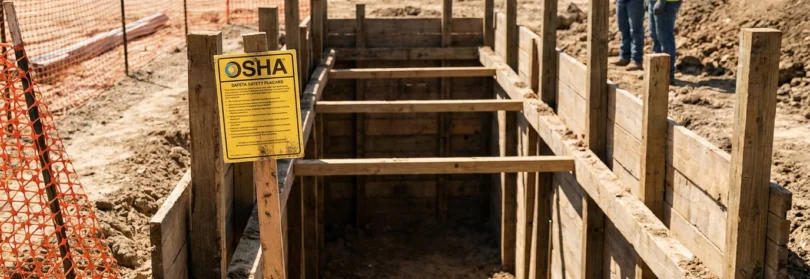
Trench collapses are among the deadliest construction accidents in Texas. OSHA identifies cave-ins as the greatest risk in trenching work and requires employers to protect workers through sloping, shoring, or shielding, along with competent-person inspections and safe means of egress. When these protections are missing, a collapse can leave catastrophic crush injury claim Texas issues involving permanent disability, lost wages, future medical care, or wrongful death.
Why This Conroe OSHA Probe Could Matter Beyond the Citation File
An OSHA investigation often becomes the first roadmap for what happened. Investigators examine whether the trench had proper sloping, shoring, or shielding, whether a competent person performed required inspections, whether workers had safe exit access, and whether spoil piles or equipment were too close to the trench edge. These facts may become central to excavation safety violations civil liability Texas claims.
The regulatory and civil sides overlap frequently. A citation doesn’t automatically establish negligence in a lawsuit, and its absence doesn’t defeat a claim. Texas Civil Practice and Remedies Code Section 72.053 (see Chapter 72) provides that evidence of noncompliance with a regulation may be admissible if it tends to prove proximate cause, but that statutory rule applies to civil actions involving commercial motor vehicles and does not generally govern construction or trenching cases; in excavation cases, OSHA findings may still be relevant and admissible under general evidentiary principles and case law, which is why families monitor both the OSHA file and site evidence through the Texas regulation evidence rules.
The Rules That Often Sit at the Center of a Trench Collapse Case
Most trench collapse cases rise or fall on basic excavation rules. OSHA’s excavation standard requires a competent person to inspect excavations, adjacent areas, and protective systems before work and after hazard-increasing events. If that person finds evidence of a possible cave-in or protective-system failure, exposed employees must be removed until precautions are taken.
Several other trenching requirements often become major liability points. Employers must keep excavated material at least two feet from the edge, determine underground utility locations before digging, provide safe egress in trenches four feet or deeper within twenty-five feet of lateral travel, and keep workers out of excavations with accumulated water unless adequate precautions exist. These requirements appear in the federal excavation safety standard, and they often frame whether a trench and excavation collapse lawyer Houston families consult will view the case as involving systemic safety failures.
Safety Failures That Commonly Drive Litigation
Certain trenching failures repeatedly appear in severe injury and fatality investigations:
- No sloping, shoring, or shielding despite known cave-in risk
- No competent-person inspection before work or after changing conditions
- No safe egress in a trench four feet or deeper
- Spoil piles or equipment too close to the trench edge
- Workers left inside after warning signs of instability
- Water accumulation or utility hazards not properly addressed
In a civil case, each failure may matter differently for notice, causation, and identifying the company that controlled excavation work.
A Houston Family Scenario That Shows How These Cases Often Unfold
Picture a worker from north Houston sent to a Conroe-area site for underground utility work. He enters a trench near shift’s end with no trench box, spoil piles near the edge, and rain-softened soil. Minutes later, the wall gives way, causing fatal crush injuries.
His family may face two separate systems. One involves workers’ compensation benefits if coverage applies. Another involves a third-party civil claim against companies whose negligence contributed to the collapse, including a site owner, general contractor, excavation contractor, or subcontractor.
The legal structure becomes fact-sensitive quickly. Texas law preserves many third-party claims against legally responsible non-employer actors, which is why families need careful review of contracts, coverage documents, and site-control evidence as reflected in the Texas third-party recovery statute.
Workers’ Compensation May Not Be the End of the Case
Many families are told workers’ compensation is the only path forward, but that may be incomplete. Under Texas law, an injured employee or legal beneficiary may pursue workers’ compensation benefits and also seek damages from a liable third party. This principle is especially important in multi-employer construction settings where responsibility for trench safety may be split across several companies.
The workers’ compensation structure can create threshold issues. A written coverage agreement between a general contractor and subcontractor may limit a direct suit against the general contractor in some circumstances. But that rule isn’t universal, and it doesn’t erase claims against others whose conduct contributed to the collapse.
When Subcontractor Layers Complicate Liability
Construction defendants often try to diffuse blame across contracts, crews, and job titles. In trench collapse litigation, lawyers may need to determine who controlled excavation methods, who selected or failed to provide protective systems, who conducted inspections, and who had authority to stop the work.
Texas law addresses anti-avoidance concerns in subcontracting. If a subcontractor is used in a way that doesn’t create workers’ compensation immunity for a particular defendant, or if statutory requirements weren’t satisfied, the injured worker or family may retain a separate right of action in a third-party claim subcontractor trench collapse Texas case.
Wrongful Death Claims Focus on Family Losses, Not Just the Worksite Violation
A fatal trench collapse case is about far more than a citation. For a surviving spouse, children, or parents, Texas wrongful death law may allow claims for damages including loss of companionship, mental anguish, and certain pecuniary losses. These claims often require detailed presentation of the worker’s role in the family, expected earning capacity, benefits, and the daily support that disappeared with the death.
These cases also may involve a survival component covering conscious pain and suffering, medical care, or other compensable losses before death.
Damages Often Extend Beyond Immediate Bills
In serious trench collapse litigation, the financial damage picture can be substantial. Damages future medical care lost wages trench injury claims may include rehabilitation, mobility limitations, diminished earning capacity, and ongoing household support needs. In fatal cases, the focus shifts to lifetime economic loss to the family and profound non-economic harm.
Punitive or exemplary damages may also become part of the analysis. Texas law may allow exemplary damages under limited circumstances, typically requiring proof such as gross negligence. If OSHA identifies willful or repeated trenching violations, that could become a major litigation issue.
What Evidence Often Matters Most in a Houston Trench Collapse Case
The first weeks after a collapse can shape the entire case. Site photographs, trench measurements, soil conditions, weather data, daily inspection logs, subcontract agreements, training records, and witness accounts may all become critical. So can utility-marking records, equipment placement evidence, and documents showing whether a trench box or shoring system should have been in place.
Families often look beyond the incident headline. A competent person’s inspection records, internal safety emails, and prior complaints about trench conditions can be important when showing notice and preventability. Readers wanting broader context may find value in this discussion of the OSHA Fatal Four hazards, since trench cases frequently arise from rushed production and ignored safety controls.
Questions That Can Reveal Corporate Responsibility
The strongest cases often come from asking precise questions early:
- Who controlled the excavation plan on the day of the collapse?
- Who supplied or omitted the protective system?
- Who conducted the daily inspection, and was that person truly qualified?
- Who knew the soil, water, or spoil-pile conditions were unsafe?
- Which companies had contractual safety duties on the project?
- Whether workers’ compensation coverage agreements existed, and how they affected claims
These questions often determine whether a case involves one negligent employer, several third parties, or a broader pattern of institutional failure.
Why Trial-Ready Case Development Matters in Severe Excavation Cases
Serious trench collapse cases are often defended aggressively because damages can be enormous. Corporate defendants and insurers may dispute site control, causation, worker status, and the meaning of OSHA findings from the start. A family evaluating whether to speak with a houston construction accident lawyer will often need a firm prepared to analyze contracts, preserve site evidence, work with qualified professionals, and build a case that can withstand attacks on both fault and damages.
How Does This Impact Me?
If my family member died in a trench collapse, do we automatically have a lawsuit?
Not automatically. Available claims depend on who employed the worker, whether workers’ compensation applied, and whether another party’s conduct caused the collapse. The answer turns on contracts, site control, OSHA evidence, and specific facts of the incident.
Can OSHA violations help prove negligence in a Texas civil case?
They may, but usually not by themselves. Texas law allows evidence of regulatory noncompliance in certain cases if that evidence tends to show the violation was a proximate cause of the injury or death. OSHA findings can be powerful, but courts still require proof connecting the violation to what happened.
What if the general contractor provided workers’ compensation coverage?
That may affect who can be sued directly, but may not end the case. Under certain written coverage agreements, a general contractor can be treated as the employer for workers’ compensation purposes. Third-party claims against other negligent companies may still be available depending on project structure and facts.
Does this change any deadline to act?
It doesn’t create a universal new deadline. Civil filing periods, workers’ compensation reporting rules, and other notice requirements differ. Because evidence in a construction site fatality investigation Houston area case can disappear quickly, waiting can create practical problems even before a legal deadline arrives.
What should an injured worker or family do in the first days after a collapse?
Focus on preserving information and understanding which legal track applies. This includes securing incident reports, witness names, photographs, employment and subcontracting information, and communications about trench conditions or prior safety complaints. Early legal review helps identify whether the matter involves workers’ compensation only, a third-party case, or both.
What This Means for Houston Families After a Trench Death
The Conroe trench collapse investigation is a reminder that excavation deaths are rarely random events. They often involve a chain of preventable failures such as missing protective systems, inadequate inspections, unsafe spoil placement, ignored water conditions, or breakdowns in site supervision across multiple companies. For Houston families, the legal significance lies not only in what OSHA may cite, but in whether available evidence can show who created the danger and how resulting losses should be valued.
For people facing catastrophic injury or loss, the stakes are deeply personal and financially severe. When a case involves serious harm and complex liability, careful analysis of the facts, contracts, and governing Texas law may be essential to understanding what options exist.
N/A:
- Are all legal claims and statutes legally accurate and nuanced?
- Do all legal claims address exceptions or limitations when applicable?
- Do any legal claims or facts contradict one another?
- Are any legal claims or facts partially correct?
- Could any legal claims or facts be clearer and more concise?