
The Number Every Houston Concrete Worker Should Know
Key Takeaways: The OSHA silica dust limit on Houston construction sites is 50 micrograms of respirable crystalline silica per cubic meter of air as an 8-hour time-weighted average, with an action level of 25 μg/m³ triggering exposure assessment and monitoring. Medical surveillance is required for employees wearing respirators under the standard for 30 or more days annually. Federal OSHA enforces this limit directly in Texas, which has no state plan covering private employers. Construction work is governed by 29 C.F.R. § 1926.1153, allowing employers to follow Table 1 controls or use alternative methods with mandatory exposure assessment; full compliance has been required since September 23, 2017. High-risk tasks like dry cutting, grinding, jackhammering, and drilling can exceed safe levels quickly, yet many contractors skip inexpensive water-fed blades, shrouded tools, and ventilation. Because silica disease develops over years, injured workers may have workers’ compensation, nonsubscriber, or third-party claims with fact-dependent deadlines worth reviewing promptly after diagnosis.
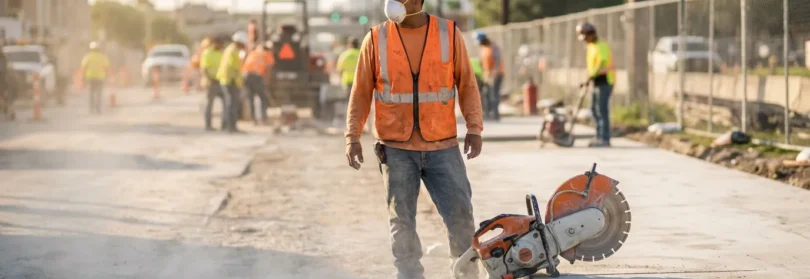
The federal construction silica standard caps worker exposure at 50 micrograms of respirable crystalline silica per cubic meter of air, averaged over an 8-hour shift. That limit governs every Houston job site because Texas has no state OSHA plan covering private employers. An action level of 25 micrograms per cubic meter triggers exposure assessment and employer duties. For workers cutting, drilling, grinding, or demolishing concrete across Harris County, those numbers often mark the difference between a normal career and a lifetime of oxygen tanks.
If you developed serious lung disease after years of silica exposure on Texas job sites, the team at Fibich, Leebron, Copeland & Briggs is prepared to investigate what your employer, the general contractor, and equipment suppliers knew about the dust. Call 713-751-0025 or contact us now to discuss what happened on your site.
Why the 50 Microgram Silica Limit Exists
OSHA set the respirable crystalline silica PEL because inhaled silica particles cause permanent, progressive lung damage. Silicosis is the occupational pneumoconiosis attributed to silica exposure, illustrated radiographically through calcified pulmonary nodules that develop quietly over years before shortness of breath appears.
That long latency period makes these cases legally complex. A laborer who spent a decade dry-cutting concrete in Houston may not receive a diagnosis until the scarring is irreversible. The damage cannot be undone, and losses include permanent disability, decades of future medical care, and the end of a physically demanding career.
Silica-related lung disease rarely announces itself with a single accident report. Unlike a fall or crane collapse, there is no dramatic moment on the job site. Building a strong claim depends on employment records, air sampling data, product identification, and physician testimony connecting the disease to specific work.
How the OSHA Silica Standard in Texas Applies to Construction Work
Construction work falls under 29 C.F.R. § 1926.1153, not the general industry rule. The respirable crystalline silica construction standard applies to all occupational exposures in construction work, with a narrow exception where employee exposure will remain below 25 μg/m³ under any foreseeable conditions.
The compliance clock ran out years ago. Construction employers were required to comply with all requirements by September 23, 2017. Enforcement is in effect today, meaning a contractor claiming confusion about its obligations in 2026 faces a difficult argument.
Two Compliance Paths Under 29 C.F.R. § 1926.1153(d)
Employers choose between two routes. An employer may fully implement the engineering controls, work practices, and respiratory protection listed in Table 1 for a covered task, or use alternative exposure control methods. The alternative approach requires assessing employee exposures and limiting them to the PEL of 50 μg/m³.
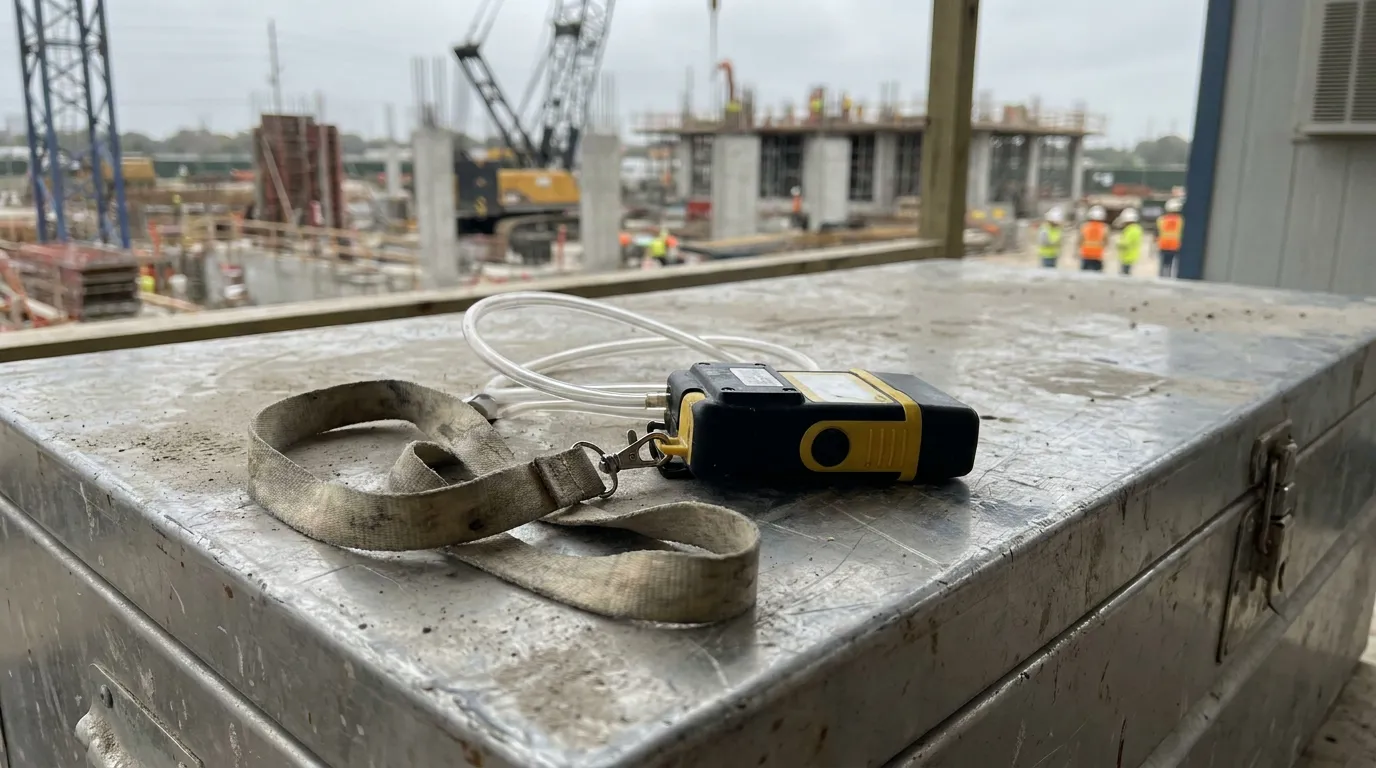
Where an employer chooses alternative methods, exposure assessment becomes mandatory. Section 1926.1153(d)(2) requires assessing the exposure of each employee who is or may reasonably be expected to be exposed at or above the action level. Missing or incomplete air sampling records frequently become significant evidence in litigation.
| Threshold | Concentration (8-hour TWA) | General Significance |
|---|---|---|
| Action level | 25 μg/m³ | Triggers exposure assessment and periodic monitoring obligations |
| Permissible exposure limit | 50 μg/m³ | Enforceable federal exposure limit for construction work |
| NIOSH recommended limit | 50 μg/m³ | Advisory recommendation for up to a 10-hour workday, 40-hour week |
Medical surveillance under § 1926.1153(h) is keyed to a different trigger: it must be offered to employees required by the standard to wear a respirator for 30 or more days per year.
The "Competent Person" Requirement Contractors Often Ignore
The standard requires a competent person on site. Under § 1926.1153(b), a competent person is someone capable of identifying existing and foreseeable respirable crystalline silica hazards and authorized to take corrective measures. On many Houston sites, this role exists only on paper.
When no one with authority watches the dust, exposures climb. Investigators often find the designated competent person was a foreman with no training, no monitoring equipment, and no power to shut down a saw. That institutional failure may support claims against multiple parties, including general contractors who retained control over site safety.
💡 Pro Tip: If you still have access to your job site, photograph the tools you used and note whether they had water suppression or vacuum dust collection attachments. That documentation may become difficult to obtain later.
Recognizing Silica Dust Exposure Construction Sites Create Every Day
Certain tasks generate dangerous concentrations almost instantly. Silica dust exposure construction sites produce most often comes from work on concrete, brick, block, mortar, and engineered stone. Common high-risk activities include:
- Dry cutting or sawing concrete, block, and masonry
- Handheld grinding, chipping, and tuckpointing
- Jackhammering and demolition of concrete structures
- Drilling into concrete, including dowel drilling in roadway work
- Abrasive blasting and dry sweeping of accumulated dust
Federal health researchers documented how quickly these tasks exceed safe levels. The NIOSH recommended exposure limit is 50 micrograms per cubic meter as a time-weighted average for up to a 10-hour workday during a 40-hour work week. Water-fed blades, local exhaust ventilation, and shrouded tools are widely available, comparatively inexpensive, and reflected in OSHA’s Table 1 controls.
Dust hazards rarely travel alone on a job site. Crews exposed to unchecked silica frequently face other serious risks, which is why understanding the OSHA Fatal Four hazards matters for evaluating overall site safety culture.
Texas Rules That Reach Silica Sources Beyond the Job Site
Texas regulates dust at the source as well. While the enforceable workplace exposure limit comes from federal OSHA, Texas law separately addresses air emissions from concrete batch plants. Under Texas Health and Safety Code § 382.05198(a), each cement or fly ash storage silo and weigh hopper at a standard-permit plant must be equipped with a fabric or cartridge filter meeting an outlet grain loading standard no greater than 0.01 grains per dry standard cubic foot.
The statute also mandates specific dust-suppression practices. Sections 382.05198(a)(11) through (13) of the Texas Clean Air Act provisions require paved roads and parking areas be maintained, cleaned, and watered to minimize dust emissions, that stockpiles be sprinkled or covered, and that spilled batch material be immediately cleaned up.
These state rules are enforced by the TCEQ and generally do not create a private cause of action. They do reflect that airborne concrete dust is hazardous and controllable. Whether a violation supports liability depends on the facts, the parties involved, and how a court applies Texas negligence principles.
Legal Options After a Serious Silica Diagnosis in Houston
Injured Texas workers may have more than one path, depending on their employer’s insurance status. Texas is unusual in that most private employers may opt out of workers’ compensation. Where an employer subscribes, benefits are generally available but limited, and the exclusive remedy provision may bar a direct negligence suit against that employer. Where an employer is a nonsubscriber, an injured worker may bring a negligence action directly, and traditional defenses are limited by statute.
Third-party claims often carry significant weight in occupational disease cases. General contractors who retained control over safety, property owners, staffing agencies, and manufacturers or suppliers of defective tools or silica-containing products may all bear responsibility. Sorting out which entities controlled the dust, the schedule, and the equipment typically requires early investigation and industrial hygiene analysis.
Timing deserves careful attention. Texas generally applies a two-year limitations period to personal injury claims, and courts have recognized a discovery rule in certain latent occupational disease contexts, though interpreted narrowly. Silica claims filed in Texas are subject to special procedural requirements under Chapter 90 of the Civil Practice and Remedies Code, including a serving physician’s report. A silica dust exposure construction sites lawyer can evaluate which deadlines may apply before any expire.
💡 Pro Tip: Request your complete employment history from the Social Security Administration early. In long-latency dust cases, it often provides the clearest record of which contractors you worked for and when.
Frequently Asked Questions
1. What is the OSHA silica dust limit Houston contractors must meet?
The permissible exposure limit is 50 micrograms of respirable crystalline silica per cubic meter of air, calculated as an 8-hour time-weighted average, under 29 C.F.R. § 1926.1153(c). Federal OSHA enforces this limit directly on Houston job sites.
2. What does the action level for silica dust actually do?
The action level is 25 μg/m³ as an 8-hour TWA. Exposures at or above it trigger employer obligations to assess exposures and repeat monitoring at set intervals, even though the concentration is below the enforceable PEL.
3. Is silica exposure monitoring in Houston always required?
Not in every situation. If an employer fully implements the Table 1 controls for a listed task, exposure assessment is generally not required. Employers using alternative methods must assess exposures under § 1926.1153(d)(2).
4. Can I bring a claim if I was diagnosed years after leaving the job?
Possibly, but it depends on the facts. Texas courts have applied a discovery rule in limited latent-disease circumstances, generally construed narrowly. Because limitations analysis is fact-dependent and silica claims carry additional statutory filing requirements, prompt consultation after diagnosis is advisable.
5. Does an OSHA violation automatically prove my case?
No. The OSH Act does not create a private right of action, and a citation is not conclusive proof of liability. A citation may be relevant evidence of the standard of care and notice, but Texas negligence law requires proof of duty, breach, causation, and damages.
What Accountability Looks Like in a Silica Case
Silicosis and related dust diseases often do not resolve. They can progress, limit breathing, and end careers built on physical labor, leaving families to absorb lost wages and years of future medical costs. The federal standard drew a clear line at 50 micrograms per cubic meter, with an action level at 25. When companies disregard those measures and a worker’s lungs pay the price, the responsible parties may be called to answer for it.
If a serious lung diagnosis has upended your family after years on Houston job sites, Fibich, Leebron, Copeland & Briggs is ready to examine the monitoring records, the contracts, and the corporate decisions behind the dust. Call 713-751-0025 or request a case evaluation to talk with our team.
Disclaimer: This content is for informational purposes only and is not legal advice. Every case is unique, and results may vary. Consult an attorney about your specific circumstances.